
A sustained tone is not minimal simply because it is quiet or long. It becomes minimal when a composer lets a few audible decisions carry the structure: where a sound begins, how its grain shifts, how long it decays, and what remains around it. In Japanese ambient work, that discipline appears in recordings made with acoustic instruments, synthesizers, tape, found materials, environmental recordings, and studio processing. The common ground is not a national character or fixed aesthetic, but compositional practices in which reduction makes timbre, duration, and listening conditions matter more.
That distinction matters because “Japanese ambient” is often reduced to a promise of calm. A sparse record may be tender, but it can also be abrasive, unresolved, memorial, architectural, or technically exacting. Minimalism does not erase tension; it moves tension into small shifts that a busier arrangement might hide.
Reduction is an active form of composition
Sonic minimalism is sometimes described as a lack of events. It is better understood as a deliberate limit on materials and operations. A piece may use one oscillator, a narrow chord vocabulary, a looped bell, or a handful of taped sounds, yet it still needs internal logic. Its interest may lie in an interval between pitches, a gradual filter adjustment, a change in density, or the arrival of an almost imperceptible recording artifact.
Japanese ambient recordings offer several different models. Hiroshi Yoshimura’s work often leaves short, lucid sounds enough room to act as spatial markers rather than melodic statements. Midori Takada’s percussion-led compositions show how repeated acoustic gestures can keep moving without building conventional musical drama. In another register, ambient and environmental work associated with artists such as Takashi Kokubo shows how designed sound can make a room or imagined setting feel inhabited without pushing every detail into the foreground.
These examples are not a unified school. They differ in purpose, instrumentation, recording context, and historical placement. What connects them is an economy that asks each sound to earn its place.
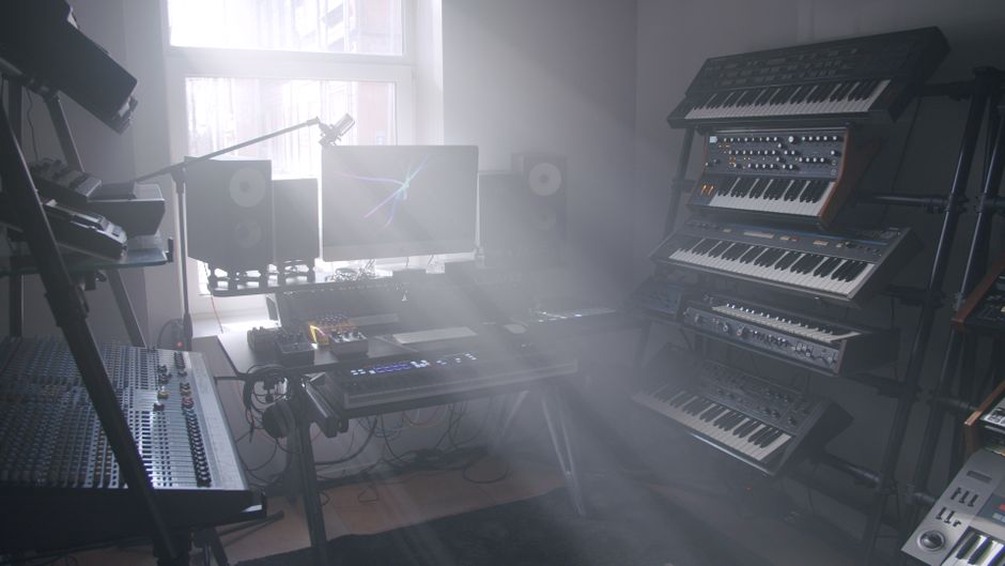
What becomes audible when layers are removed
In dense music, the ear can move among several lines and textures. In a minimal work, the listener may notice a mallet attack, the unstable edge of a synthesizer waveform, a breath before a flute tone, tape hiss, or the way reverb obscures a cutoff. These are not incidental technical details. They can be the composition’s main material.
- Attack: whether a sound arrives as a click, a softened impact, a swell, or an abrupt cut.
- Decay: how quickly a sound disappears and whether its tail merges with the next event.
- Register: the vertical placement of sound, especially important when only two or three layers are present.
- Grain: the fine texture of a tone, including hiss, bow noise, digital aliasing, or tape irregularity.
- Recurrence: the return of a gesture, which can establish continuity without requiring a beat.
- Negative space: not passive empty time, but a measured interval that changes the force of what follows.
Minimalism also makes weak decisions harder to hide. A reverb preset that seems merely pleasant in a crowded mix can become overwhelming when it is one of only two audible elements. A field recording added for “atmosphere” may feel decorative if it has no structural relation to the other sounds. Reduction calls for editing, not a generalized mood.
Duration changes the scale of detail
Long duration is common in ambient music, but length alone is not a method. A twelve-minute piece can be productively static or simply underdeveloped. The question is whether time allows hidden features to emerge. A drone may reveal beating between close frequencies; a sequence may slowly fall out of alignment as tape speed drifts; a room recording may change as traffic, ventilation, and distant activity alter its spectrum.
It helps to separate events from processes. An event is a struck note, a loop entry, or the moment a recording begins. A process is the continuing change: an overtone fading, a feedback path settling into another pitch, or an equalizer moving so slowly that the shift is felt before it can be clearly identified. Much of the strongest ambient minimalism gives priority to processes.
Track length also cannot be judged apart from playback. Headphones reveal low-level edits and recording flaws; speakers reveal how a sustained low tone interacts with a room. At very low volume, an apparently uneventful recording may hover at the edge of audibility. Turn it up, and the same piece may reveal physical pressure, rough harmonics, or a carefully controlled stereo field.
For a broader account of how sustained sound depends on material and duration, Listening to Japanese Drone: Material, Duration, and Context clarifies several of the listening conditions shared by drone and sparse ambient practice.
Space is not a decorative backdrop
Minimal ambient works often suggest space, but that does not always mean they document an actual place. Space can be captured with microphones, simulated through digital or mechanical reverberation, assembled from layered recordings, or implied through frequency balance and silence. A sense of scale may come from a distant high-frequency sound, a close dry object against a long tail, or a low drone that seems to extend past the speakers.
Japanese composers working across environmental music, installation, and ambient traditions have often treated playback space as part of a work’s practical meaning. Music intended for public interiors, exhibitions, domestic settings, or commercial environments may require a different restraint than concert music. It may need to coexist with footsteps, ventilation, speech, and uneven attention. That does not make it “background music”; it means function and listening mode can be built into the arrangement.
Foreground, background, and shifting attention
The foreground/background divide is too rigid for this repertoire. A sound can recede while continuing to shape perception. A faint loop may pass unnoticed for several minutes, then become impossible to ignore after another layer drops away. The most convincing sparse works organize this instability instead of assigning every sound a fixed role.
| Listening feature | What it can do in a minimal piece | Common misreading |
|---|---|---|
| Silence or near-silence | Frames attacks, reveals room noise, resets expectation | Assumed to mean nothing is happening |
| Repetition | Creates a reference point for minute deviations | Dismissed as lack of development |
| Reverb | Establishes depth, continuity, and scale | Treated as automatic atmosphere |
| Field recording | Introduces unstable external time and texture | Used as an exotic signifier of place |
| Noise floor | Connects separate sounds and makes a recording feel material | Edited out as a technical defect |
Field recordings require particular care. A station announcement, rain on a roof, birds, appliances, or distant traffic can be structurally rich, but none automatically represents a place truthfully. Recording conditions, editing, captioning, and placement in the mix all alter what is heard. Sparse ambient work is strongest when recorded environments remain ambiguous rather than serving as shorthand for authenticity.

Material limits can sharpen the work
Restrictions are central to many DIY methods: a borrowed recorder, a four-track cassette machine, a small set of pedals, a damaged speaker, or one inexpensive keyboard can become a compositional framework. The point is not nostalgia for obsolete gear. Limits force decisions that are otherwise easy to postpone: whether to keep a flawed take, how many overdubs are necessary, or when a loop has developed enough internal variation.
Tape is useful here. Saturation rounds transients, hiss creates a continuous bed, and repeated copying removes high-frequency information. A musician may use these effects deliberately, but tape alone does not make a recording minimal. If every layer is processed into the same soft haze, articulation disappears. Contrast still matters: a dry tick against a blurred pad, a clear upper tone over degraded low material, or a pause that interrupts the tape bed.
Small labels and self-released work have also shaped the circulation of minimal music. Cassettes, CD-Rs, limited digital editions, and direct exchanges can support recordings that do not fit standard genre expectations. The format should not be romanticized as proof of artistic freedom or archival durability, however. Tape demagnetizes, digital storefronts disappear, and informal documentation can make later identification difficult. The practical networks behind these releases matter as much as the objects themselves; DIY Infrastructure in Japanese Experimental Music examines the labels, venues, and exchange systems that make such circulation possible.
How to listen without turning restraint into mythology
Writing about Japanese sound often falls back on ideas of purity, serenity, nature, or spiritual silence. Such shortcuts obscure the work of arranging, recording, editing, and mastering. They also leave out music that is synthetic, urban, noisy, humorous, commercially commissioned, or deliberately uncomfortable. Minimalism is a technique, not evidence of a national essence.
A practical listening method keeps attention on what the recording actually does:
- Listen once without trying to identify influences or assign a mood.
- On a second pass, count major changes: entries, exits, cuts, shifts in register, and changes in reverberation.
- Choose one sound and follow it through the entire piece. Note whether it repeats exactly, degrades, drifts, or changes its relation to the others.
- Lower the volume, then raise it moderately. Compare which details appear and which disappear.
- Listen in another room or on another system if possible. Sparse bass and long decays often change more than expected.
This does not require technical expertise. It replaces vague claims of “emptiness” with observations that can be tested. A work that first seems motionless may contain constant spectral movement, while one that seems richly layered may depend on a single gesture and its reflections.
For musicians: designing a minimal piece with intention
Beginning with fewer sources helps, but the important step is defining the relationship between them. Try building a piece from one sustained sound and one intermittent sound. Decide in advance what each may change. The drone might alter only in brightness, while the intermittent sound changes only in timing. Those limits are clear enough for the listener to hear.
Before introducing a third layer, test whether the first two have distinct roles. If they occupy the same frequency range, decay at the same rate, and share the same reverb, they may not create complexity; they may only thicken the surface. A third element should bring a different temporal behavior, physical texture, or depth cue rather than simply more ambience.
Try a three-minute recording with no overdubs, then make only two edits: remove one section and lengthen one silence. Export it without normalization. The next day, listen at a moderate volume and mark the exact second when attention begins to drift. Often the useful revision is a ten-second cut, not another sound.