
A sustained blast of feedback can leave you without a beat to count, a melody to remember or a chord change to expect. But it is rarely motionless. The high frequencies sharpen; a low pulse surfaces; a sudden cut lets the room come through beneath the amplification. In Japanese noise, “anti-music” is a name for the challenge such sounds pose to familiar ways of listening—not a claim that nobody is thinking about what they make.
What does “anti-music” reject?
The term needs a target. A performance may dispense with stable pitch and meter yet depend on exact timing. It may reject the clean separation of instruments familiar from studio recordings while relying on careful control of gain and volume. Another piece might avoid building to a climax, then end with a deliberately abrupt cut. Calling all three “against music” conceals the different conventions at stake.
Anti-music is not a fixed Japanese genre label, either. Artists, critics and listeners have used related language to celebrate confrontation or to dismiss sounds they struggle to classify. Noise is not exclusive to Japan, and Japanese experimental music cannot be reduced to a taste for extremity. The question is less whether a recording counts as music than which assumptions about music it strains.
That question predates these recordings. John Cage’s work brought chance, environmental sound and the limits of intentional listening into debates about composition. Britannica’s account of Cage offers a point of reference, though Japanese noise is no mere extension of his ideas. Its histories also pass through rock, free improvisation, electronics, performance and independently circulated recordings.
A history of contested boundaries
Postwar Japanese experimental music was never one practice. In collective experiments around 1960, Group Ongaku explored improvisation alongside instruments, objects and recording techniques. Later scenes took shape under different circumstances. From the late 1970s onward, artists associated with Japanese noise pursued excess, abrasion and unstable electronics in ways that unsettled familiar genre divisions. These practices intersect; they do not form a straight line from a founding group to a single style.
Merzbow, Hijokaidan, Incapacitants and Hanatarash indicate the range. Across a vast body of recordings, Merzbow has explored dense electronic noise with changing equipment and methods. Hijokaidan’s work is bound up with volatile live improvisation; Incapacitants’ performances bring physical gesture and electronic interaction to the fore. Hanatarash became notorious for confrontational performance as well as sound. “Loud” tells us little about what separates them.
“Japanoise” helped listeners find records, but the shorthand can flatten differences and create an expectation of maximum intensity. For a closer look at the naming problem, Japanese Noise Music and Cultural Heritage: Listening Beyond Stereotypes considers the danger of treating experimental sound as an expression of timeless national character. Anti-music tells us more when it points to a particular choice in a performance rather than an imagined cultural temperament.
How refusal becomes a method
Removing familiar points of orientation
Noise can interrupt the habits we use to identify a musical work. Distortion may hide the source of a sound; a continuous mass may resist division into phrases. Saturation can press small events into what seems like a solid surface, while abrupt edits deny the smooth transitions expected of many recordings. None of these devices makes a piece interesting on its own. Listen to how long a sound holds, how densely it fills the space, which frequencies stand forward and when it breaks.
Suppose a performance starts at full intensity instead of building toward it. Without the expected rise, smaller differences come forward: a rougher texture, one frequency gaining ground, feedback wavering against a steadier layer. What first sounds like a refusal to develop can make minute changes matter. A different performance might repeatedly cut an active signal to silence, so that each return feels altered in scale.
Keeping decisions audible
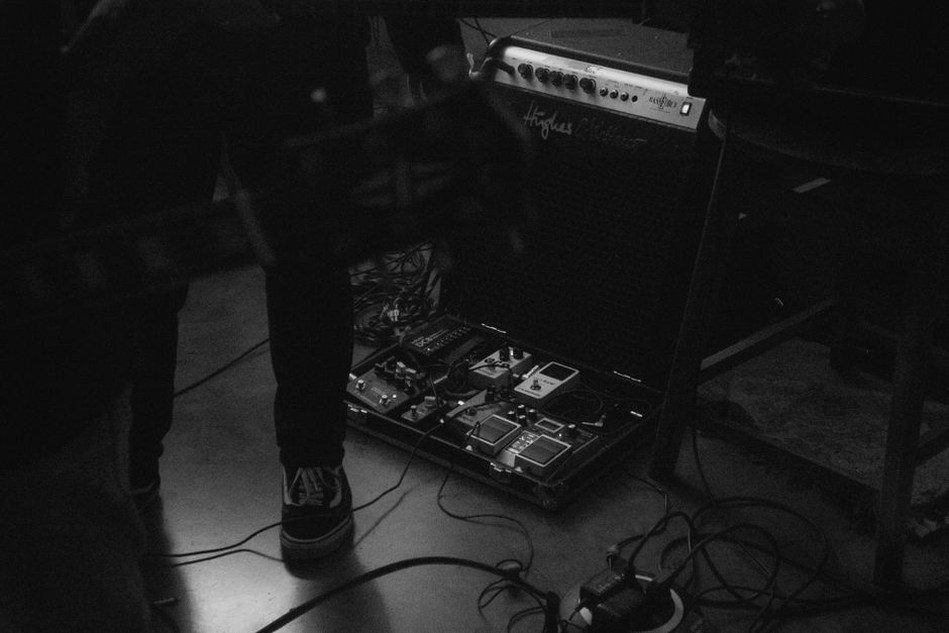
Anti-music is sometimes mistaken for a rejection of skill. Working with feedback, microphones, amplifiers or effects calls for choices about proximity, routing, gain and timing. A performer cannot necessarily control every fluctuation, but can set the conditions for it—and decide when to let it run. The result sits between design and instability.
Recordings invite the same attention. Distortion might originate in an instrument, an effects chain, an overloaded input or a mastering decision, with different results in each case. Harshness is not proof of accident, any more than clarity proves intention. Instead of judging sound quality on a clean-versus-damaged scale, listen for what remains distinct and what gets pressed together.
Does anti-music oppose its own audience?
Confrontation can be part of a noise performance, but context changes what it means. A loud set in a small venue acts on bodies sharing an acoustic space. At home, the listener has a volume control and a pause button, along with different risks. Studying a recording at moderate volume is no failure of authenticity. If a passage hurts or exhausts you, turn it down; quieter structural changes may become easier to hear.
Talk of anti-music can also hide the relationships behind the work. Performers exchange techniques, play together, attend one another’s sets and circulate releases. Refusing conventional form does not mean refusing community. How Collaboration Shapes Japanese Noise and Experimental Music looks more closely at those shared practices. Even an uncompromising solo performance involves decisions about venues, audiences, recording and distribution.
Nor does anti-music mean anti-pleasure. One listener may enjoy the pressure, surprise or humor; another may follow microscopic detail or the unpredictable behavior of a familiar device. Someone else may find the same work tedious or needlessly punishing. Neither response settles whether it is music. The term is more useful when it names a relation to a convention, such as refusing a steady pulse, rather than assuming how everyone will feel.
Listening without forcing a melody
With a dense recording, follow one dimension for a short stretch. Rather than identifying every source, notice changes in frequency range, apparent distance or the length of pauses. Replay the passage with a different focus. This can help separate decisions from accidents without assuming every detail belongs to a hidden composition.
- Time: Does an event repeat, gradually shift or stop without warning?
- Layering: Can you hear separate signals, or do they merge into one mass?
- Space: Does the recording reveal an audience, room or microphone movement?
- Thresholds: At what point does a hum become distortion, or distortion become silence?
Those observations still leave room for disagreement. A performer may draw attention to sound as material while a listener hears an assault on the expectations of a song. The tension is part of what keeps “anti-music” useful. Try sixty seconds of a recording at a comfortable level: mark the first change you hear, then describe what happened without deciding whether it was musical.