
Japanese noise did not grow directly out of any single traditional art form. Its most visible figures worked with damaged electronics, extreme amplification, tape manipulation, bodily performance, and networks of record shops and galleries rather than inherited repertories. Cultural heritage still matters, though—not as an exotic code hidden in every burst of feedback, but as a set of institutions, listening habits, materials, histories, and disputed ideas about modernity that shaped the conditions in which noise could be made and heard.
That distinction matters. Treating Japanese noise as an expression of a timeless national essence turns a diverse, internationally connected field into a stereotype. Better questions are practical and historical: which performance traditions were available as reference points? How did postwar media and urban life alter sound? Where did experimental artists find places to work? How did artists accept, revise, or reject the cultural labels placed on them?
Heritage as a living set of practices, not a sonic template
Traditional Japanese music is often discussed in terms of space, timbral detail, irregular pacing, and attention to gesture. Those qualities may help listeners notice aspects of noise, but they do not prove that harsh electronic sound “comes from” gagaku, nō, shakuhachi music, or Buddhist practice. The lineages, social settings, instruments, and purposes are different.
A more careful comparison concerns sound as an event rather than simply a sequence of notes. In many Japanese performing traditions, attack, decay, breathing, silence, physical movement, and the relation between performers and room carry structural weight. Noise artists often organize performances through pressure, density, interruption, duration, and the behaviour of equipment. That is a shared concern with musical material, not evidence of direct inheritance.
Traditional arts can also suggest models of disciplined repetition and embodied technique. A performer working with feedback, contact microphones, a mixer, or a modified instrument develops a physical vocabulary over time: distance from speakers, hand pressure, cable movement, gain staging, and the timing of interruption. The labour can be as exacting as conventional instrumental practice, even when the result refuses stable pitch or meter.
Ma is useful only when used precisely
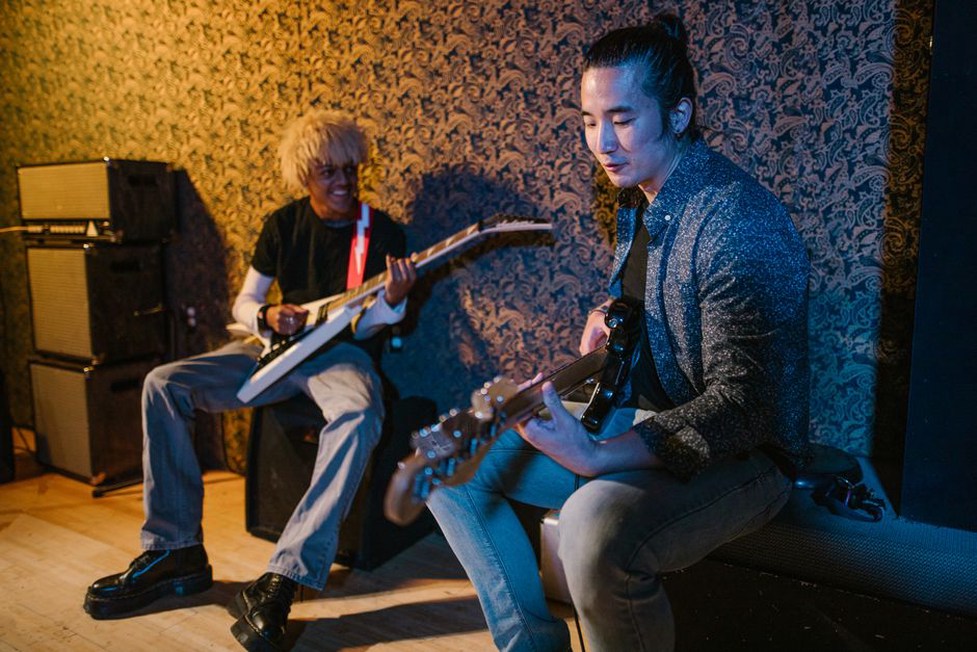
Ma is commonly translated as interval, gap, or negative space. It appears often in writing on Japanese experimental music, and often too casually. Noise is not automatically an art of ma because it contains pauses, nor does a continuous wall of sound become culturally Japanese because someone calls it meditative.
Used with restraint, the term can describe a specific listening relation: meaningful spacing between sounds, actions, bodies, or acoustic events. In a noise performance, a sudden loss of signal can reset the room’s attention; after dense distortion stops, a low electrical hum may take on unexpected force. These are compositional and situational effects. They should be heard in the work itself, rather than assigned in advance through a cultural explanation.
Postwar rupture and the problem of modernity
The heritage most immediately relevant to Japanese noise is not ancient tradition alone. It is also the unsettled postwar history in which artists encountered technology, consumer goods, American and European avant-gardes, rapid urban development, political protest, and the aftereffects of war. Experimental scenes developed amid arguments over reconstruction and modernization: should art preserve inherited forms, absorb international influences, or invent entirely new means?
Artists and groups associated with postwar intermedia practice challenged fixed boundaries between music, theatre, visual art, and everyday action. The influential collective Hi-Red Center, active in the 1960s, staged events and interventions that drew attention to urban systems, surveillance, cleanliness, consumption, and public behaviour. It was not a noise-music group, but its work belonged to a broader context in which disruption and contingency could expose social routines.
Fluxus activity in Japan, experimental film, free improvisation, and work around venues and art spaces helped establish permission to treat sound as material, action, and disturbance. By the 1970s and 1980s, artists using tape, electronics, junk instruments, performance, and amplified objects were working in conditions already changed by these experiments. Noise was one outcome of that history, not an isolated eruption.
The phrase “Japanese noise” became useful internationally, yet it can hide uneven local realities. It gathers artists with very different methods: Merzbow’s long engagement with recorded and electronic sound; Hijokaidan’s volatile collective performance history; Incapacitants’ confrontational vocal and electronic intensity; and the instrumental destruction and feedback associated with groups such as Hanatarash. Their work connects with industrial music, free improvisation, punk, tape culture, and visual-performance traditions around the world as much as with any local inheritance.
Urban infrastructure as cultural material
Noise music’s heritage includes the concrete systems of Japanese cities: compact live houses, rehearsal rooms, record shops, commuter rail, construction, vending machines, arcades, public-address systems, apartment walls, and the close overlap of commercial and domestic sound. These are more than atmosphere. They limit rehearsal, shape ideas of volume and privacy, supply found materials, and affect where audiences gather.
Tokyo, Osaka, Kyoto, Nagoya, and smaller regional scenes offered different combinations of venues, artists, labels, and access to equipment. Reducing that geography to “the sound of Tokyo” overlooks local organizers and small spaces. The same applies to media formats. Cassettes, photocopied inserts, mail correspondence, and small independent labels circulated music through practical networks long before online platforms made distant catalogues easier to find.
Mechanical and consumer technologies carry their own historical charge. A broken tape deck, cheap effects unit, portable recorder, or overloaded amplifier is never culturally neutral, but none carries a fixed national meaning. Artists repurpose available technology according to budget, access, taste, and venue conditions. The sound may retain the life of particular objects: worn motors, tape hiss, voltage instability, defective switches, and the physical strain of amplification.
Archives, packaging, and the heritage of circulation
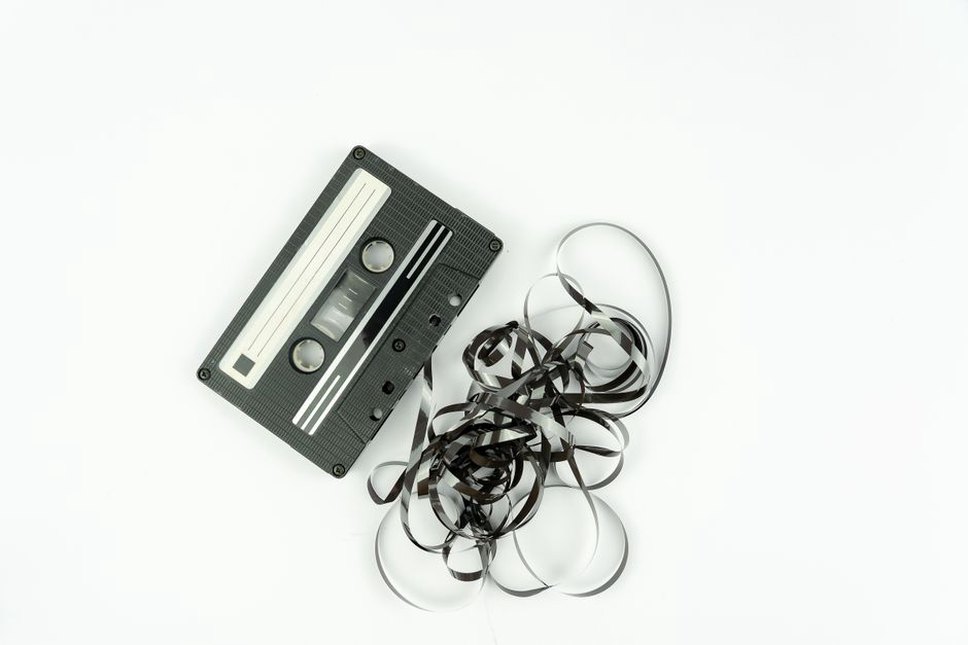
For collectors, cultural heritage often appears in the material traces around recordings: handwritten labels, inserts, catalogue numbers, venue flyers, correspondence, and duplicated cassettes. These objects document relationships as much as music. A tape may suggest that an artist had access to a label’s duplication setup, exchanged work through the mail, or performed within a small concert network. It may also reveal very little; incomplete credits and inconsistent documentation are common.
That uncertainty calls for careful archival habits. Do not turn missing information into folklore. Record what can be confirmed from the object itself, distinguish verified credits from later claims, retain scans of inserts, and note a copy’s condition and provenance. Underground collecting invites readers to attach meaning to every cryptic marking, particularly when an item is scarce. Scarcity shows limited circulation, not automatic artistic importance.
Digital circulation has widened access while changing the role of physical artifacts. Files can preserve audio that might otherwise disappear, but scans and metadata are often separated from the social context that made a cassette meaningful. The tension between preservation, access, and incomplete documentation is central to the digital transformation of Japanese noise music, especially when older releases return online without full archival detail.
Reception abroad and the risks of cultural shorthand
International listeners have often received Japanese noise through a narrow vocabulary: extremity, precision, technology, ritual, discipline, or a supposedly unusual tolerance for intensity. Such descriptions can obscure individual choices and historical circumstances. They also impose a one-way model in which Japan supplies “otherness” while European and North American experimental traditions serve as neutral standards. Noise has always moved through exchange, influence, touring, record distribution, journalism, and collaboration.
A stronger critical account follows actual connections. Merzbow’s industrial and tape-based methods belong to a transnational network of experimental recording practices. Keiji Haino’s work spans improvisation, rock, voice, and sustained attention to timbre. Otomo Yoshihide’s projects link turntablism, improvisation, composition, film, and collective performance. None requires a simplified cultural explanation to be understood.
How to listen without reducing the work
- Start with method. Identify audible processes: feedback loops, editing, tape degradation, acoustic objects, voice, saturation, or changing amplifier behaviour.
- Check the setting. A live document, studio construction, gallery installation, and privately issued cassette place different demands on sound and audience.
- Separate evidence from association. A listener may hear affinities with traditional performance, but affinity is not a documented influence.
- Follow networks. Labels, collaborators, venues, and formats often explain a work more clearly than broad national categories.
- Leave room for disagreement. Noise changes with volume, space, playback equipment, and listener experience; a single authoritative interpretation is rarely enough.
Heritage can also be refused
Artists may invoke Japanese forms, but they may just as readily reject the expectation that they represent Japan at all. That refusal belongs to the cultural field. A work can be shaped by Japanese institutions, language, urban conditions, and media history while remaining hostile to nationalist representation or uninterested in tradition as a source of legitimacy.
For writers and listeners, the most responsible practice is specific attribution. If a sleeve cites an instrument, location, performance tradition, or historical event, describe that connection and verify it where possible. If no evidence exists, describe the sound’s audible construction instead. On a cassette with an unidentified contact-microphone source, it is more accurate to note the scrape, resonance, and recording proximity than to assign it an inherited cultural meaning.