
“Merzbow with Boris” tells you who is credited, but not how the music was made. Did they play together in a room, exchange recordings, or reshape a session through editing? In experimental music, the person who makes a sound, the person who places it in the mix, and the person who cuts it may all shape what reaches the listener. Following those decisions tells us more than assuming two names add up to a louder version of each artist.
Partnerships take many forms: long-running bands, one-off improvisations, recordings assembled across locations, and performances that share space with another medium. They cross genre labels, too. A noise musician may work with a rock group; an improviser may bring a turntable or synthesizer into an acoustic ensemble. The recordings and accounts that survive point less to a single unified scene than to overlapping relationships, each with its own idea of how musicians respond to one another.
What changes when musicians share control?
Volume is only one thing to negotiate. There is also duration, frequency range, pace, and the possibility of leaving a gap alone. In a dense performance, one artist can make another’s quiet material nearly inaudible. In a sparse one, an abrupt noise can recast everything that came before it. These choices may happen as the players perform, or later in the edit and mix. A collaborative album is not necessarily a document of one continuous encounter.
Several working relationships can produce superficially similar sounds:
- Established groups develop habits through repeated playing. Their sound belongs to the working relationship, not just a roster of individual techniques.
- One-off meetings bring together musicians with less shared vocabulary. Misunderstanding and adjustment may become audible parts of the performance.
- Recording exchanges allow one contributor to respond to material that cannot react in return. Editing and mixing become central compositional acts.
- Cross-disciplinary work may give a visual artist, dancer, filmmaker or organizer real influence over timing and attention, even if that person makes no sound.
These are methods, not rankings of spontaneity or value. Nor is method always clear by ear. A tightly coordinated passage may have been improvised by players who know each other well; an apparent collision may be an edit. Credits, release notes and participants’ accounts can help establish the process. The recording lets you hear how the parts meet.
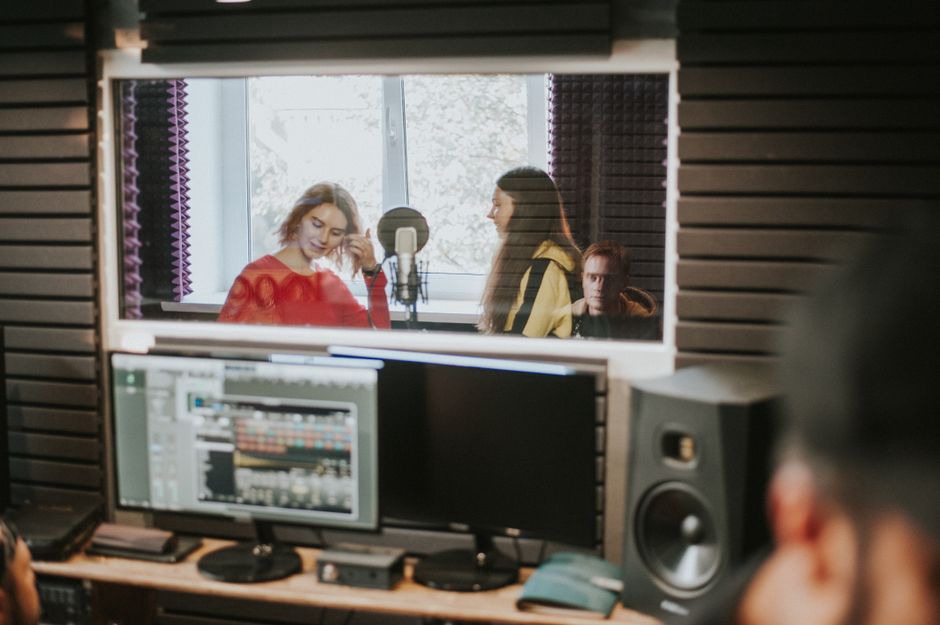
Partnerships that unsettle genre borders
Merzbow and Boris: density meets a band
Merzbow, Masami Akita’s long-running project, and Boris, a band that moves between heavy rock and experimental forms, have made several collaborative recordings, including Sun Baked Snow Cave and Rock Dream. This is not simply abstract noise laid behind conventional songs. Boris’s riffs, percussion and sustained amplifiers meet Akita’s electronic sound, raising a question that shifts from passage to passage: where does the band’s pulse begin, and where does it disappear into the larger mass?
There is no fixed “Merzbow–Boris sound.” A sustained tone can sit behind the band in one passage and mask it in another. Drums may offer a point of orientation without pulling everything into a rock arrangement. Listen for a familiar musical gesture that holds its shape, then for one whose source becomes hard to assign. That changing balance is more revealing than sheer intensity.
Fushitsusha: collaboration inside a group
Keiji Haino’s work with Fushitsusha offers another model. The group has had different lineups, with Haino’s voice and guitar working against and alongside bass and drums. To hear it solely as the expression of a front person is to miss what a rhythm section can do: hold a figure until it changes character, resist an acceleration, or make a sudden pause count. The musicians are not equally prominent, but the music depends on their interaction.
Collaboration here need not sound like polite turn-taking. Friction, repetition and long stretches of playing are part of the group’s language. A revealing moment may come after an apparent climax: do the players stop together, continue at different rates, or leave one instrument exposed? Shared timing explains more about such a passage than a genre label does.
Otomo Yoshihide and Sachiko M: making less space
Otomo Yoshihide and Sachiko M have worked together in projects associated with the onkyo approach, notably Filament. Otomo’s turntable and guitar practices and Sachiko M’s sine-wave work challenge the assumption that collaboration means adding layers. When both players limit their contributions, a nearly continuous high tone, a small disturbance or a long stretch with little overt activity can become an event.
Restraint is not inherently more sophisticated than noise; it distributes responsibility differently. In a loud duo, adding material may be the easiest way to assert a presence. In a sparse one, an entrance is exposed. Sound in the listener’s own room may become noticeable, although home playback cannot reproduce the conditions of a particular performance. Changes in duration and placement can tell you more about the exchange than a dramatic gesture.
For a closer look at density, repetition and interruption across different recordings, the blog’s discussion of structural elements in Japanese noise music is a useful companion to these examples of shared decision-making.
The network is broader than the most familiar pairings
Well-known pairings can narrow the view. Phew’s work suggests relationships beyond a simple noise-versus-rock divide. Her 1981 self-titled album involved members of Can alongside Japanese collaborators. International participation does not confer significance by itself; what matters here is how her voice works within a setting built by musicians with different histories. The recording cannot be reduced to Phew alone or to her collaborators’ reputations.
Improvised groups pose a related question of authorship. In the late-1990s trio I.S.O., featuring Otomo Yoshihide, Sachiko M and Yoshimitsu Ichiraku, no one needs to carry a melody for the ensemble to have a recognizable way of operating. Each sound enters a field the others have already changed. The group’s identity lies partly in the musicians’ continuing choices around one another. A credit naming all three is useful, but it cannot explain the music on its own.
These examples do not represent every region or generation of Japanese experimental music. The surviving record favors partnerships that were recorded, released, distributed and discussed. Informal rehearsals, short-lived groups and performances without usable documentation are harder to trace. Even a detailed discography shows what became public, not everyone who helped a musician develop a practice.
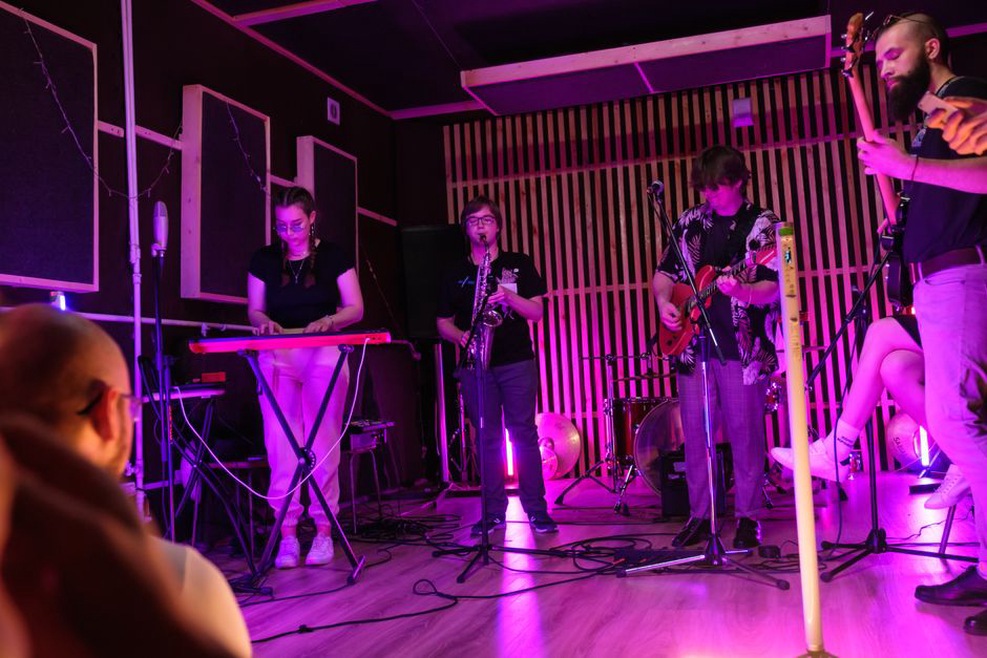
How a collaboration gets from room to listener
“Collaboration” can hide a chain of practical decisions. Someone proposes a meeting, arranges time and equipment, records it, chooses what to keep, prepares the release and writes the credits. A venue or organizer may bring musicians from separate circles together; a label may make a fleeting encounter available to people who were not there. Those roles do not automatically amount to artistic authorship, but ignoring them makes a partnership seem more self-contained than it was.
Format changes the account, too. A live release preserves aspects of a meeting while detaching the sound from the room, audience and physical volume. A studio recording permits closer control of balance and repetition; an edited release may contain only a small part of a longer session. When noise pushes extremes of frequency or level, mastering and home playback can change the relationship between delicate details and dense passages. The release is worth hearing on its own terms, not as unmediated access to the session.
Read credits with the same care. “With,” “featuring,” a shared artist line and a group name need not imply the same division of work. Liner notes that name a recorder, mixer or editor may help explain why one musician’s gestures remain clear while another’s sit in the background. When documentation is silent, describe what you hear rather than assigning every sound to a person.
Listening for negotiation, not just signatures
Start with a short passage, not an entire discography. Choose two or three minutes in which both contributors seem active, then replay it with a different question each time:
- Find an anchor. Is there a pulse, a recurring frequency, a sustained amplifier sound or a repeated gesture? Notice who, if anyone, maintains it.
- Mark a response. When a new sound enters, does another change, stop or continue unaffected? Continuing can be a meaningful choice; it does not necessarily mean the players failed to listen.
- Check the balance. Does one element mask another, or does the texture open enough to expose it? Use moderate playback levels rather than trying to recreate concert loudness.
- Read the credits afterward. Compare your impressions with the documented instruments and production roles. Leave unresolved sources unresolved.
This approach helps resist the urge to treat each musician’s sound as a fixed signature. Tools change, and collaborators use familiar ones differently. A player known for extreme density may leave room for an ensemble; a band known for riffs may sustain a texture instead of moving a song forward. Ask not only which sound might belong to whom, but what these musicians made possible—or ruled out—by working together.
Collectors can apply the same care to their notes. Record the exact artist credit and release title, then note whether the source identifies the work as live, studio-recorded or assembled from exchanged material. Add named editing and mixing roles when they are available. If the sleeve gives no answer, leave that field blank. Keeping what the release establishes separate from what listening suggests is a small habit, but it can prevent a guess from becoming part of the story.