
Ask ten noise musicians about their tech rider and you get ten different answers—assuming you get an answer at all. In the Japanese underground, where shows often happen in tiny live houses, basements, or someone’s living room, the concept of a formal rider can feel like an import from stadium tours. Yet one blown fuse, one humming ground loop, or one feedback system that refuses to speak can turn a set into a struggle session. The tech rider is not a power move; it is a map for making the invisible infrastructure of experimental sound visible before the first patch cable is plugged in.
What a Tech Rider Is (and Isn’t) for Experimental Music
A technical rider is a document that tells the venue or promoter exactly what the performer needs to execute their set. For a punk band, that might mean “two 4×12 cabs, one SM58, monitor mix from FOH.” For a noise act it usually looks different: no backline, no vocal mics, but a list of power outlets, table space, grounding conditions, and perhaps a quiet room with dim light. The rider isn’t a wishlist or an ego trip. It is a practical tool for bridging the gap between a musician’s personal setup and the unpredictable reality of a venue’s electrical and acoustic environment.
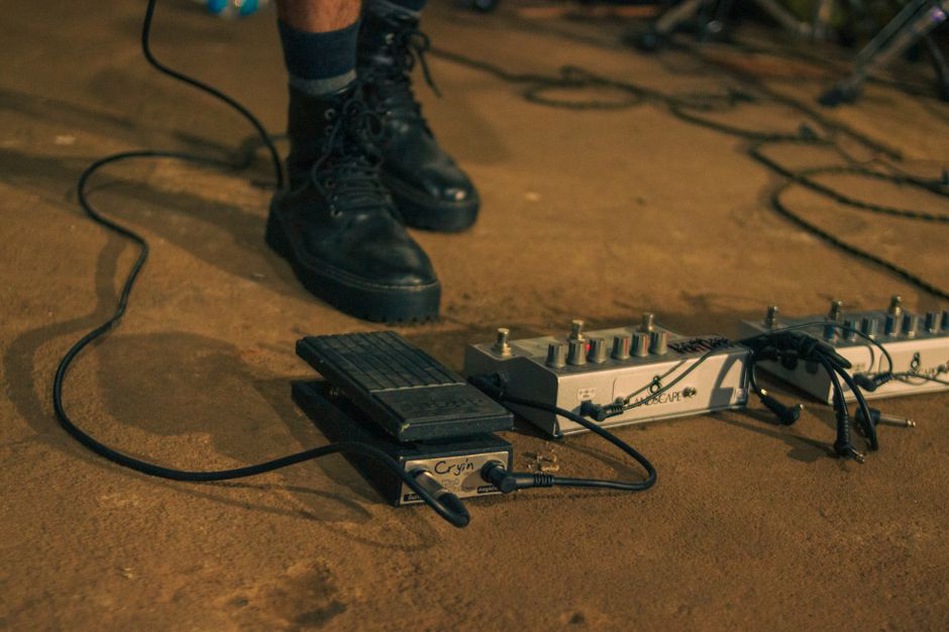
In the Japanese scene, where many artists work with tape loops, self-built electronics, contact microphones, and repurposed consumer gear, the rider takes on extra importance. A piece of hardware that works perfectly at home in a dry apartment may glitch, drop out, or hum when plugged into a bar’s overloaded circuit shared with a refrigerator and a dodgy PA. Writing a rider forces the performer to think through failure points in advance: which outlet feeds the amplifier, whether the laptop needs a pure sine wave UPS, or whether the table surface will rattle when the floor tom hits.
The Specifics of Noise and Drone Riders
Standard rock riders rarely cover the needs of drone or electroacoustic sets. A typical noise rider might include:
- Power: total amperage needed, number of separate circuits, isolation from lighting dimmers, and optional grounding verification.
- Stage layout: specific dimensions for a table or platform, clear space for feedback loops, no wedge monitors on the floor (they rattle hard drives and feedback sources).
- Audio specs: line-level inputs to PA (if needed), monitor as a second independent channel (not just a copy of mains), or no PA at all for room-as-instrument pieces.
- Contact microphones and odd transducers: they require phantom power at a specific voltage, or need a preamp with variable impedance.
- Lighting: often minimal or darkness requested, strobes prohibited for certain visual-sensitive works.
Many Japanese noise artists work with multiple amplifiers placed in different corners of the room to create phase cancellations and standing waves. A rider that specifies “four 50W guitar amps (clean channels only), each on separate 15A circuit, positioned on floor at marks A-D” is not pretentious—it is the difference between a controlled wall of sound and a muddled hum.
The DIY Ethos vs. Venue Reality
The tension between improvisation and infrastructure is central to the experimental underground. A performer who prides themselves on an ever-changing, chaotic rig may resist formalizing a rider. Yet the most fluid sets often rely on a stable baseline: a trust that the electricity won’t sag, that the ground loop can be killed at the source, that the stage is not a drum riser vibrating into contact mics. Writing a rider doesn’t compromise spontaneity; it buys time for spontaneity by eliminating predictable failures.
Promoters in Japan’s live houses—particularly the smaller spaces—are used to odd requests. A rider saying “remove the stage curtain, I need a dark corner facing the wall” is understood. The problem arises when the rider is communicated last minute or not at all. Many underground shows rely on a quick email exchange the day before. At that point, requesting a separate transformer for a vintage synth becomes impossible. The rider needs to arrive with the booking confirmation, not with the gear van.

Common Pitfalls in Tech Riders for Underground Shows
A vague rider confuses everyone. Jargon that the venue can’t decode leads straight to mistakes. Here are frequent issues observed in Japanese DIY contexts:
- Missing power details: saying “2 x IEC sockets” without specifying voltage, amperage, or whether they can share a single circuit. For gear that draws 100mA but also a 500W bass amp, a shared circuit may trip the breaker.
- Assuming house PA is optional: many punk venues have a PA designed for vocals only. If the set requires a flat-response system with subwoofers, state it. Conversely, if no PA is needed, say so clearly.
- Forgetting to mention tape/chemicals: some performances use open reels, contact mics glued to surfaces, or even prepared instruments that leave residue. Mention if the performer brings their own table cover or if a clean table is mandatory.
- Not accounting for humidity or temperature: tape loops and analog delay units behave differently in hot, damp basements. Specifying a climate-controlled green room may be unrealistic, but noting that gear must be allowed to acclimate for 30 minutes is practical.
A useful habit is to have one person in the group—or the label runner—act as a rider translator. Instead of “I need a 50Hz notch filter at FOH,” write “please kill the 50Hz hum on channel 3 using the graphic EQ.” Communication must match the venue’s technical literacy.
Beyond the Gear: Hospitality and Space
A rider also sets expectations for the space itself. Experimental performers often need time—not just soundcheck, but dedicated setup and breakdown windows. For drone acts with slow-evolving textures, a rushed changeover can ruin a carefully built atmosphere. A rider that requests “no loudspeaker announcements during set, no door bang” is not pretentious; it is respectful of the work.
Hospitality items are minimal in underground settings: a quiet corner, drinking water, a single power strip for charging. Some Japanese noise musicians request a small private room (or at least a curtained area) before the set to focus. Others want to meet the audience and talk gear—both preferences are valid when stated.
The rider itself can become a collector’s artifact. Over the years, certain Japanese noise artists have circulated minimal riders that are almost conceptual art: a single line reading “table, 100V, dark.” Others are absurdly precise, listing the brand of electrical tape and the distance between outlets. These documents, much like the cryptic filenames found in underground archives, reveal how each artist constructs their performance from its hidden conditions.
If you are an artist building your first rider, start small. Write down the three things that most often went wrong at your last three shows. Address those. For a typical noise duo with a laptop, a mixer, and one combo amplifier, the rider might be: “One 180cm x 90cm sturdy table (not plastic folding type), two separate power outlets on different breakers (15A each), no piano or music stands on stage, and a 5-minute silence before start for feedback tuning.” That level of detail gives a venue something to work with, while leaving space for whatever the night throws at you.