
A feedback tone holds steady, yet it seems to change shape as you cross a room. Near a wall, one frequency swells; a few steps away, it thins out. Nothing has changed at the loudspeaker. Reflections and standing waves have changed what reaches your ears. That gap between the sound produced and the sound heard can matter in Japanese experimental music, in a concert room or gallery as much as on a recording played at home.
Space is more than a location
“Site-specific” can conceal quite different decisions. An artist may work with a room’s reverberation, put speakers among listeners, route a microphone back into the space, or leave a window open to sounds outside. Reverberation changes a sound after it begins. Speaker placement changes where it seems to come from. An open window admits events the performer cannot schedule.
A short click makes reflections relatively easy to hear: its tail may linger or return from a particular surface. A sustained drone brings out resonances, though it can be hard to tell where the instrument’s harmonics end and the room’s contribution begins. Even the gaps between sounds matter. They can expose ventilation, footsteps and audience movement without making any of those noises the stated subject of the piece.
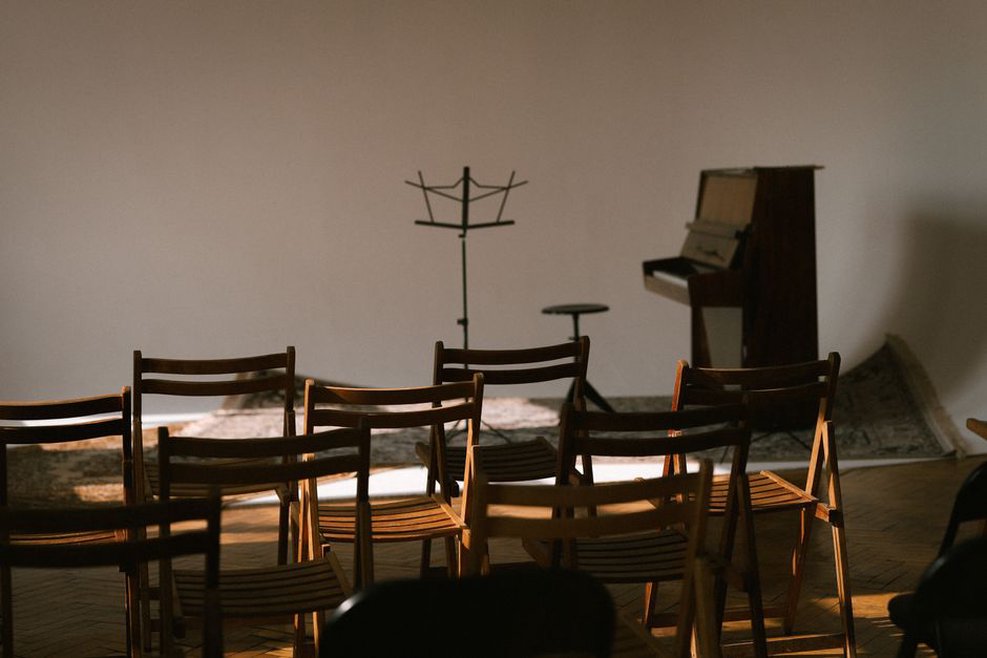
Movement changes the composition
Some works ask listeners to move; others change for listeners simply because they do. Toshimaru Nakamura’s no-input mixing board performances show why position matters even when the source is electronic. The board produces sound through internal feedback, but loudspeakers still deliver it into a particular room. A sharp frequency may press hard in one seat and recede in another. That difference does not mean the performance has failed to translate. It tells you something about the playback environment.
Before walking around at a concert, check whether movement is welcome. In a seated room, a slight turn of the head may be enough to hear a change without disturbing anyone. A gallery usually offers more freedom: try listening near a speaker, at a doorway and in the middle of the installation. You are not looking for the correct spot. You are hearing how a fixed signal meets changing acoustic conditions.
Acoustics and playback are different decisions
Japanese experimental music includes amplified noise, quiet improvisation, electroacoustic work and installations, with no standard speaker arrangement shared by all of them. A sound from one speaker at the front of a room draws attention differently from the same sound spread across several. Multiple channels might move it, separate competing sounds, or make it hard to pick out any dominant speaker. Even a two-speaker setup depends on the speakers’ distance from the walls and the listeners.
Acoustic instruments add another complication. A bowed cymbal projects frequencies unevenly, so what you hear beside the player may differ from what reaches the back of the room. A close microphone can catch tiny surface noises while diminishing the sense of the cymbal’s natural projection. A distant one takes in more of the room but may lose detail. Neither is a neutral account, and a recording may mix both perspectives.
This is one reason a live performance can sound unlike its recorded document. A stereo file can retain timing, texture and some directional information. It cannot let you walk among the speakers, and it cannot reproduce a venue’s bass response unchanged through every pair of headphones. “Recorded live” tells you where the recording came from, not how faithfully it conveys the space.
Place enters the work without becoming its explanation
A station announcement, electrical hum and a passing vehicle can each suggest a location, but with very different degrees of precision. A recognisable announcement might identify a transport system; hum may tell us only that equipment was present. Hearing every such trace as a portrait of Japan puts more weight on the recording than it can bear. Listen instead to what the work does with a sound. Does it leave the source identifiable, break it into fragments, set it against another location, or use it mainly for its rhythm?
Sound artist Akio Suzuki offers a related way to listen. His practice includes exploring how sounds behave at particular sites and how a change of position changes the act of listening. The place is neither a passive backdrop nor a ready-made composition: the artist’s actions, the site’s acoustics and the listener’s access all matter. A documentation recording may convey some of those actions while leaving distances and sightlines uncertain.
If a recording comes without venue notes, these questions help more than a guess about geography:
- What locates the sound? Listen for reflections, background activity and shifts in apparent distance, as well as recognisable voices or traffic.
- What might be a production choice? Panning, close microphones and added reverberation can suggest a space that did not sound that way during the performance.
- What remains unknown? Without microphone and speaker details, an ambiguous acoustic trace is not enough to identify a particular room or street.
The room carried inside a recording
Space keeps affecting the music after it has been recorded. Cassette hiss can mask a quiet reverberant tail; compression can pull background sounds forward. Headphones take away the room between loudspeaker and listener but bring the sound unusually close. None of these formats is inherently more authentic. Each lets different spatial cues through.
You can test some of those differences with a short passage. Play it through speakers at a moderate level, then listen to the same file on headphones. Does a background sound sit behind the main source or merge with it? Does a low tone gain or lose prominence? Play it through the speakers once more and take a step sideways. If the bass shifts with you rather than at a particular moment in the file, much of that change belongs to your room.