
Unusual materials do not automatically make a sound collage cohere. A clipped radio voice, a train-door warning, bowed metal, room tone, and a damaged cassette loop can still feel arbitrary when their entrances, overlaps, and disappearances have no audible logic. In Japanese experimental music, collage has often mattered less as a display of sonic abundance than as a way of reorganising attention: making mediation, interruption, proximity, and residue audible.
The term covers several related practices. It can mean editing existing recordings into a fixed composition, assembling a live set from objects, playback, electronics, and voice, or treating the recording session itself as a site of montage. The difference matters. A work built from field recordings may preserve friction between locations, while a studio collage may erase those origins almost completely. Neither approach is inherently more truthful. What matters is whether the listener can hear the decisions linking one fragment to the next.
Collage as relation, not accumulation
Japanese experimental scenes have included composers, improvisers, noise artists, sound artists, and cassette-based practitioners whose methods overlap without forming a single tradition. Historical reference points such as Takehisa Kosugi, Toshi Ichiyanagi, and the wider postwar activity around Group Ongaku and later intermedia work show how recorded sound, instruction, chance, performance action, and environmental material could function as compositional elements. Elsewhere, tape manipulation, musique concrète methods, radio interference, home recording, and free improvisation produced other forms of montage.
Collage is not a genre label. It is a way of placing sounds in relation. Sometimes the listener is meant to notice the cut. Just as often, the important event is a near-match: rain-like tape hiss continuing beneath an actual outdoor recording, or a voice fragment returning at a slightly altered speed until its meaning begins to slip.
Three useful kinds of contrast
Effective collages often use contrast across more than one dimension:
- Material contrast: a dry spoken phrase against a saturated feedback mass, or an acoustic object against a synthetic oscillator.
- Spatial contrast: close-miked handling sounds beside distant traffic, reverberant rooms, or mono archival playback.
- Temporal contrast: a repeating loop against an event that occurs only once, or a long drone interrupted by abrupt cuts.
Using all three constantly can reduce a piece to permanent surprise. It is usually more precise to choose one dominant contrast and let the remaining materials provide enough continuity to establish temporary ground. If a five-second telephone fragment is meant to intrude, its force depends on what comes before: a stable low-frequency layer, recognisable room ambience, or several seconds of near-silence.
Sources: record with a role in mind
Field recordings are often treated as raw evidence, but in collage they quickly become musical material. A station platform recording may supply rhythm through footfalls and announcements, spectral density through ventilation, or a sense of distance through reverberation. Before recording, decide which function is likely to matter. That choice affects microphone placement, duration, gain, and how much surrounding context to retain.
A useful source library sorts recordings by behaviour as well as location. Alongside filenames and dates, note whether a sound is impulsive, sustained, periodic, noisy, fragile, speech-like, or spatially distinctive. A file labelled only “Tokyo street” is difficult to retrieve compositionally; “short metallic impacts, broad street bed, intermittent bicycle bell” provides information an editor can use.
Found media calls for similar care. Broadcast fragments, commercially issued recordings, films, and online audio can be aesthetically compelling but may be protected by copyright. Brief duration, heavy processing, or low fidelity does not automatically make use permissible. For work intended for public release, use original recordings, material with clear permission or an appropriate licence, or seek qualified legal advice for the relevant jurisdiction. Legal use does not settle every ethical question: a private conversation, a vulnerable person’s voice, or a ritual context may call for restraint rather than extraction.
Editing methods that preserve tension
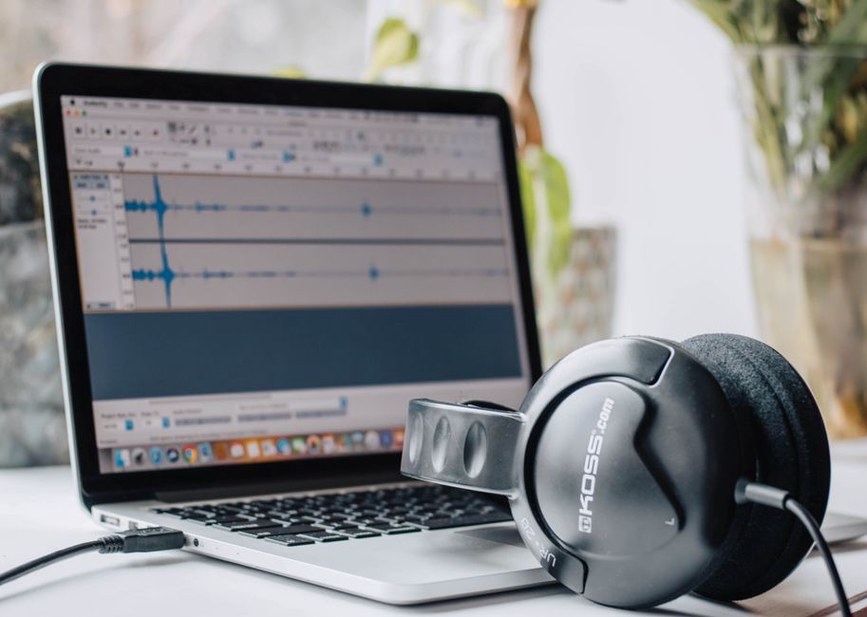
Digital audio workstations make limitless layering easy, which is exactly why reduction matters. Begin with a small number of source families—perhaps an environmental bed, a mechanical or object-based sound, a voice or radio element, and a generated texture. Build a short sequence before adding more. If it already has motion, any new layer should alter its meaning rather than merely add thickness.
Hard cuts, seams, and false continuity
A hard cut declares that two recorded times or places do not belong together. It can serve a piece that needs rupture: a quiet domestic recording abruptly displaced by distorted playback, for instance. Crossfades imply continuity, but they are not neutral. A long crossfade can create a third event in which sources merge, while a very short fade removes clicks without hiding the edit.
Treat transitions as compositional units in their own right. Instead of simply asking how to get from A to B, make a ten- or twenty-second passage in which A loses its identity and B slowly becomes legible. Filtering, speed changes, re-amping, and repeated micro-loops can serve as connective tissue. The aim is not smoothness. It is to give the listener a reason to stay with the change.
| Technique | What it emphasizes | Common risk |
|---|---|---|
| Hard cut | Discontinuity, collision, interruption | Feeling arbitrary when repeated without contrast |
| Looping | Texture, rhythm, obsessive duration | Predictability or fatigue from unchanged repetition |
| Layering | Density and simultaneous perspectives | Masking important details in the midrange |
| Re-amping | Shared acoustic space and material transformation | Losing the clarity of the original source |
| Silence or near-silence | Scale, anticipation, residual noise | Being used as a generic dramatic pause |
Re-amping can help when sources sound too separate. Play a phone recording, oscillator tone, or cassette loop through a small speaker in the same room, then record the result. The room becomes an editor: its reflections, hum, and microphone placement alter each source in related ways. This does not require expensive equipment; a modest speaker and deliberate positioning can reveal more than pristine playback.
Time, repetition, and degradation
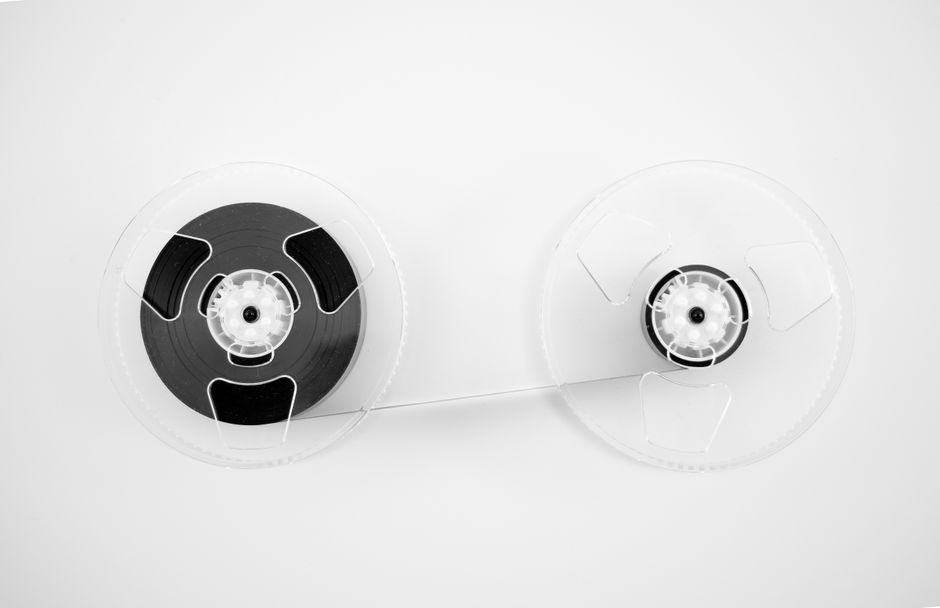
Collage often finds structure in recurrence rather than conventional melody or development. A fragment may return unchanged as a marker, return shortened as memory, or return degraded until it becomes texture. Tape-based work makes this particularly tangible: repeated dubbing adds noise, softens transients, and narrows high frequencies. Digital production can imitate such traits, but actual generational loss carries irregularities that are hard to predict and can be useful when a piece risks becoming overcontrolled.
Repetition should reveal a difference. Change the surrounding layer, shift playback speed slightly, move the loop from foreground to background, or interrupt it just before its expected return. An identical loop can still work, but its stubbornness then has to be the subject: a mechanical cycle, an inescapable phrase, a pressure that refuses resolution.
Listening critically to the archive
Collage practice also meets incomplete documentation. Untitled files, homemade tapes, partial track lists, and copied recordings may contain edits whose source histories can no longer be recovered. That uncertainty should not be romanticised. It is an archival condition with practical consequences: distinguish what is directly heard from what is inferred, retain original filenames, and document transfer details before processing a source. The blog’s examination of the orphan file known as wasted 4 in Japanese noise archiving is a useful reminder that a circulating file can acquire context without acquiring certainty.
For musicians building a collage archive, keep a simple session log. Record the source filename, recording date where known, processing steps, edit points, and whether a voice or recording requires permission for release. Save a version before destructive edits. Export an early reference mix, then return after a day and listen at a lower volume than usual. Remove the layer that merely duplicates another role, and leave the strongest cut intact. The audible seam may be the composition’s most exact piece of evidence.