
In Japan, environmental sound was being treated as compositional material well before “ambient” became a dependable marketing label. During the 1970s, artists working in electronic music, sound art, improvisation, and studio production began to treat space, timbre, and duration as structural concerns. They did not belong to a single school. Some records were intended for private listening; others grew out of gallery installations or design commissions, while still others retained close ties to pop, jazz, or electroacoustic composition.
This history is often reduced to a frictionless soundtrack for an imagined tranquil Japan. That reading misses both the technical detail and the social setting. Japanese ambient soundscapes can be bright, synthetic, awkwardly rhythmic, densely arranged, or deliberately sparse. They reflect the acoustics of studios, exhibition spaces, domestic playback systems, public architecture, and changing ideas about what recorded music could do.
Ambient as a practice, not a sealed genre
“Ambient” is useful only when it describes an approach rather than a fixed sound. Here, it can refer to music that favors atmosphere over dramatic development, leaves room for peripheral attention, or is organized through slowly shifting layers instead of verse-and-chorus contrast. It does not necessarily mean quiet music. A sustained electronic tone, close-miked water, a repeating synthesized figure, or a broad keyboard chord can function ambiently depending on placement and duration.
Japanese musicians arrived at related ideas through experimental composition, electronic instrument design, recording technology, international exchange, and the growing role of sound in commercial and public environments. Those paths overlapped. A musician might play in a band, write for film or television, work with visual artists, and release an exploratory solo record without treating each activity as a separate identity.
That overlap matters because many well-known releases are now heard outside their original contexts. A record currently filed under ambient may originally have been described as electronic music, environmental music, new age, fusion, soundtrack work, or simply a personal studio project. Retrospective labels help listeners locate music, but they can also flatten the circumstances that shaped it.
From environmental music to studio worlds
The Japanese term kankyō ongaku, usually translated as environmental music, became associated with music intended to coexist with particular spaces and activities. This was not background music in the dismissive sense. Its premise was that sound could change how a room, lobby, shop, building, or domestic setting was perceived. That raised practical and aesthetic questions: Should music demand attention? What does a repeating phrase do over several hours? Can a recording suggest openness through modest speakers?
During the 1980s, the term circulated alongside design culture, architecture, consumer electronics, and the expansion of commissioned work. Its commercial setting should not be mistaken for artistic shallowness. Limits of duration, location, playback equipment, and audience movement could produce unusual formal decisions. Music made for a space may avoid a conventional climax because listeners are expected to enter and leave at different points.
Hiroshi Yoshimura is central to this history. His catalog includes records released under his own name alongside environmental and installation-oriented projects. Albums such as Music for Nine Post Cards and Green became touchstones by balancing plainly shaped melodies with patient shifts in color and pacing. Their apparent lightness can conceal careful work with envelope, register, repetition, and the silence between events.
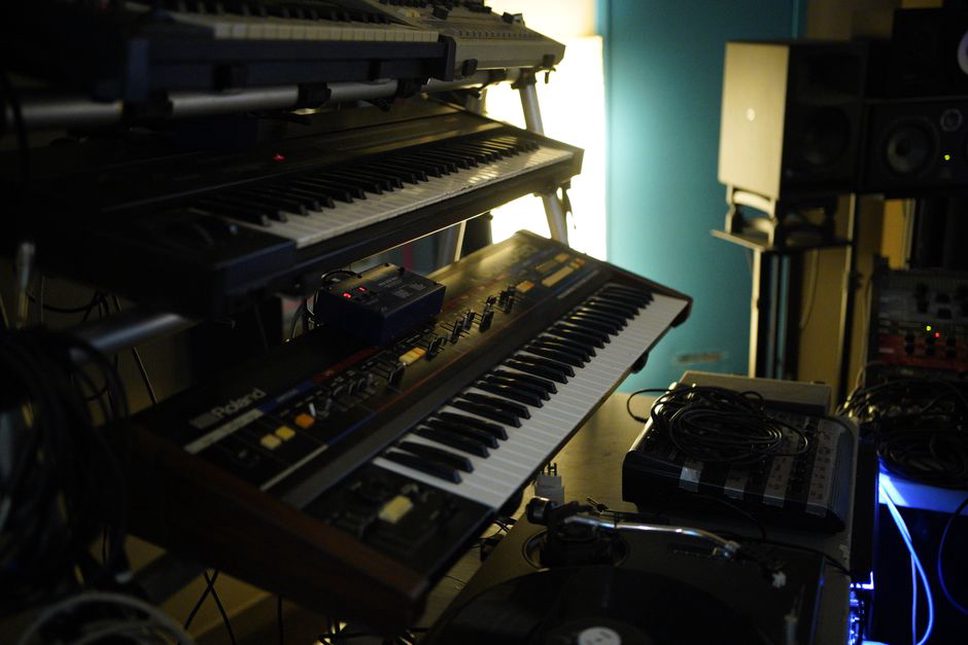
Takashi Kokubo is another essential reference point, particularly for his use of synthesized timbres, naturalistic textures, and controlled spatial depth. His recordings show that an environmental approach does not require rejecting artificial sound. A simulated bell, a soft digital pad, or a processed field-like texture can create an acoustic fiction rather than document a real place. Soundscape music often constructs environments; it does not merely capture them.
Why “nature sounds” is too narrow a frame
Birdsong, water, wind, and other environmental cues recur in ambient listening culture, but they are only part of the vocabulary. Japanese ambient recordings often place them beside clearly electronic materials: FM synthesis, sampled percussion, sequenced bass patterns, gated reverberation, or smooth keyboard voicings. The friction between organic and manufactured sound is often the point. Rather than transporting the listener outside the city, the music can place them within a designed auditory environment.
This also resists simplistic national narratives. The work emerged amid dense urban life, sophisticated recording industries, global media circulation, and local experimental scenes. A soft sound does not reveal some timeless cultural essence. It reflects decisions about production, listening, and use.
Key artists and adjacent paths
Yellow Magic Orchestra helped build broad public awareness of electronic sound in Japan, though the group cannot be reduced to ambient music. Ryuichi Sakamoto’s solo work moved through pop, soundtrack composition, piano music, electronics, and more abstract textures. His collaborations with visual artists and filmmakers also show how ambient-adjacent sound can be inseparable from image, architecture, and narrative.
Haruomi Hosono offers another route into this body of work. His career moves across folk, rock, electronic pop, exotica, production, and experimental listening. Records including Watering a Flower are often discussed as environmental music, but their importance partly lies in their refusal of stable genre identity. The music can feel domestic and intimate while remaining technologically mediated and compositionally exact.
Midori Takada’s Through the Looking Glass occupies a different zone. Percussion, tuned instruments, repetition, and studio layering create a calm surface with an active internal pulse. Its lasting appeal is not simply a “meditative” mood. Listen to the attack and decay of each sound, the phase-like shifts, and the changing accents generated by repeated patterns.
Yoshio Ojima, Satoshi Ashikawa, and other figures associated with the Wave Notation label extend the picture further. Wave Notation was not a generic ambient imprint, but a short-lived and influential setting for music connecting acoustic instruments, electronics, environmental thinking, and visual or architectural concerns. Ashikawa’s Still Way is particularly revealing in its restrained use of piano, strings, and space. Rather than filling the field, it leaves individual events exposed.
These artists are starting points, not a closed canon. Archival reissues in the 2010s and 2020s made more recordings accessible, but they also encouraged a narrow collector’s checklist. Listening only for scarce artifacts or algorithmically approved “Japanese ambient” titles can reduce a varied history to a commodity category.
Listening for construction rather than mood
Ambient soundscapes are often described only through feeling: peaceful, nostalgic, healing, floating. Those reactions are valid, but they do not explain how the records work. A closer listen begins with the elements of the mix.
- Foreground and background: Identify the element closest to the ear. Is it a melody, pulse, field recording, or sustained tone? Notice whether that hierarchy shifts.
- Time scale: Listen for changes unfolding over seconds, minutes, or an entire record side. A piece may seem static while its reverb, density, or harmonic balance slowly changes.
- Timbre: Distinguish acoustic sources from electronic imitations without assuming either is more authentic. Synthesized rain or sampled birds may serve as compositional signals rather than documentary material.
- Loop behavior: Repetition is rarely neutral. A loop can establish comfort, mild tension, rhythmic instability, or suspended motion.
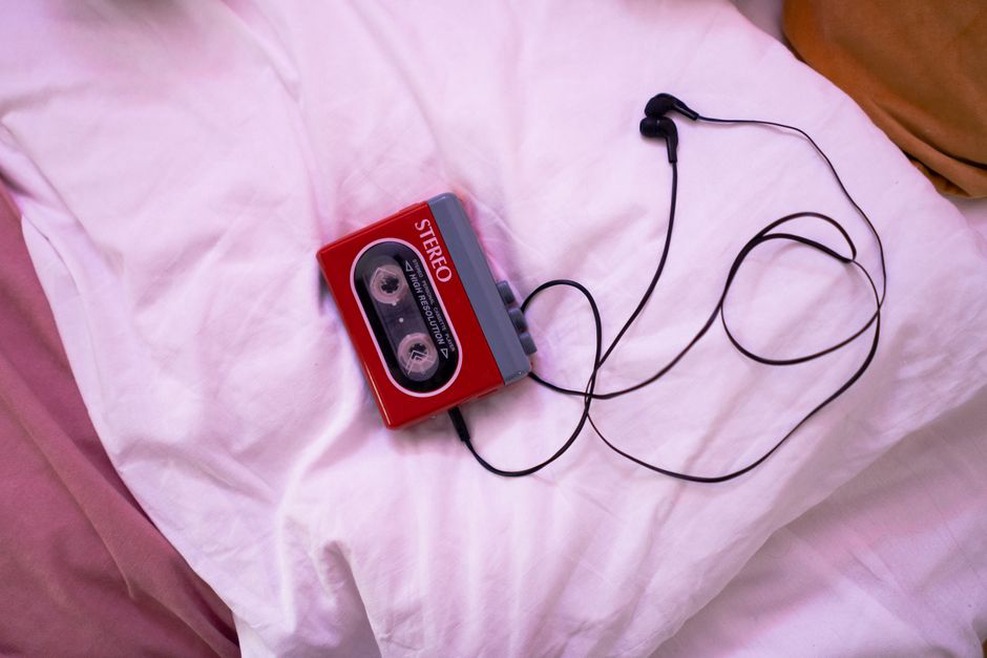
- Room and playback: Headphones reveal edits and stereo placement; speakers show how bass, reverberation, and silence interact with an actual room.
For musicians, this kind of listening offers practical lessons. A convincing soundscape rarely depends on piling up layers. More often, it comes down to editing: leaving an interval empty, reducing a competing frequency range, allowing a sound to decay completely, or choosing one distinctive texture over five interchangeable pads. The arrangement may be minimal; the decisions are not.
Field recordings: document, material, or illusion
Field recording has a complicated place in Japanese ambient practice. A recording of a location can preserve specific acoustic evidence: traffic patterns, insects, ventilation systems, rain on a surface, distant voices, or the resonance of an interior. Once edited, looped, equalized, and placed beside instruments, however, it also becomes compositional material.
The ethical and archival questions remain important. Recordists should identify places and dates where appropriate, preserve unprocessed files, and consider whether voices or privately identifiable activity require consent. A field recording is not neutral simply because it sounds unmediated. Microphone placement, duration, selection, and editing all frame what is heard.
For collectors and researchers, documentation matters just as much. Japanese underground recordings may circulate with incomplete credits, inconsistent transliterations, damaged scans, or bare file names. That uncertainty is one reason careful cataloging matters. The blog’s examination of the three-letter “tou” code in Japanese noise archives shows how a small metadata fragment can become an archival problem rather than a reliable description of music.
The relationship to noise, drone, and electroacoustics
Japanese ambient soundscapes did not develop apart from louder or harsher practices. Noise, drone, free improvisation, tape work, and electroacoustic composition shared equipment, venues, participants, and audiences at different points. The contrast between ambient and noise can mislead: both may favor texture over melody, duration over eventfulness, and physical listening over conventional song form.
The difference is often one of pressure. Noise may overload the auditory field, while ambient distributes detail across a wider, lower-intensity range. Drone can hold a sound long enough for its internal beating and overtone structure to become the subject. Electroacoustic work may foreground processing and montage. Individual recordings frequently cross those boundaries.
| Approach | Typical listening focus | Possible overlap with ambient |
|---|---|---|
| Environmental music | Space, use, unobtrusive continuity | Designed atmosphere and extended duration |
| Drone | Sustained pitch, resonance, slow change | Immersion and reduced harmonic motion |
| Electroacoustic music | Recorded sound, processing, montage | Soundscape construction and timbral detail |
| Noise | Intensity, grain, feedback, saturation | Texture-focused form and altered perception |
This wider context helps avoid another common mistake: treating Japanese ambient as the polite opposite of Japanese noise. Both labels cover varied practices, and individual artists may move between restraint and intensity without seeing any contradiction.
How to build a reliable listening path
A useful entry point is to hear several kinds of work side by side instead of working through a long anonymous playlist. Start with a Hiroshi Yoshimura recording, then compare its small-scale melodic design with Midori Takada’s percussion-led repetition. Follow with Takashi Kokubo for a more overtly environmental palette, then try Satoshi Ashikawa for sparer acoustic space. The contrasts make each method easier to hear.
- Choose one album and hear it once without multitasking.
- On a second pass, note the first appearance and disappearance of each major layer.
- Compare headphones with speakers at a moderate volume.
- Check credits, original release context, and reissue notes before repeating claims found in collector listings.
- Use “ambient” as a provisional tag when the music clearly intersects with minimalism, soundtrack work, percussion, or experimental pop.
For a physical archive, note the exact edition, label, catalog number, source of credits, and any uncertainty separately. A cassette dub, later reissue, and digital upload may have different sequencing, mastering, or artwork. This small habit is especially useful when a recording has circulated without its original information.
Try a three-minute passage from Music for Nine Post Cards: map every audible entrance on paper, then repeat the exercise with Through the Looking Glass. The first map will usually emphasize placement and tonal color. The second can show how percussion patterns create movement without requiring a conventional song-sized payoff.