
A nearly inaudible sound is not empty. In a careful recording, the electrical hum of a room, a tape mechanism settling, a distant vehicle, or a musician’s breath can establish scale before any deliberate gesture arrives. Japanese experimental music has often made these thresholds audible through particular practices of reduction, duration, recording, and attention—not through any supposedly national aesthetic of calm.
Here, minimalism is less a fixed genre than a way of working. It may involve limiting sound sources, withholding obvious development, leaving a room’s acoustics exposed, or letting a process run long enough for minor changes to matter. Sparse work can come from acoustic instruments, feedback systems, field recordings, tape, computer processing, or environmental sound left nearly untouched. What joins these methods is a refusal to treat density as proof of intensity.
Silence is a condition, not a blank surface
Absolute silence is rare in recording or listening. Microphones pick up ventilation, transformer noise, handling, distance, and a room’s acoustic character. Playback contributes its own material: headphone-amplifier noise, vinyl surface sound, cassette hiss, traffic outside the listener’s window. Minimal sound work does not always try to remove these residues. It may frame them, work against them, or let them complicate the intended signal.
The distinction matters because “quiet” and “silent” are often used loosely. A quiet piece can contain a dense field of small activity. A seemingly silent pause may be a compositional interval, a document of a space, or a moment when the medium itself comes into focus. Listening too quietly can obscure these differences; turning the volume up without care can distort them too, making room tone seem more prominent than intended.
John Cage’s 4′33″, first performed in 1952, remains a useful reference because it made the audible conditions around a performance inseparable from the work. Japan’s later experimental scenes, however, should not be treated as an afterimage of Cage. Musicians and sound artists have pursued sparseness through improvisation, contemporary composition, recording practice, electronic feedback, installation, and independent circulation. The better question is not whether a work is “influenced by silence,” but what its restraint allows us to hear.
Reduction as a technical decision
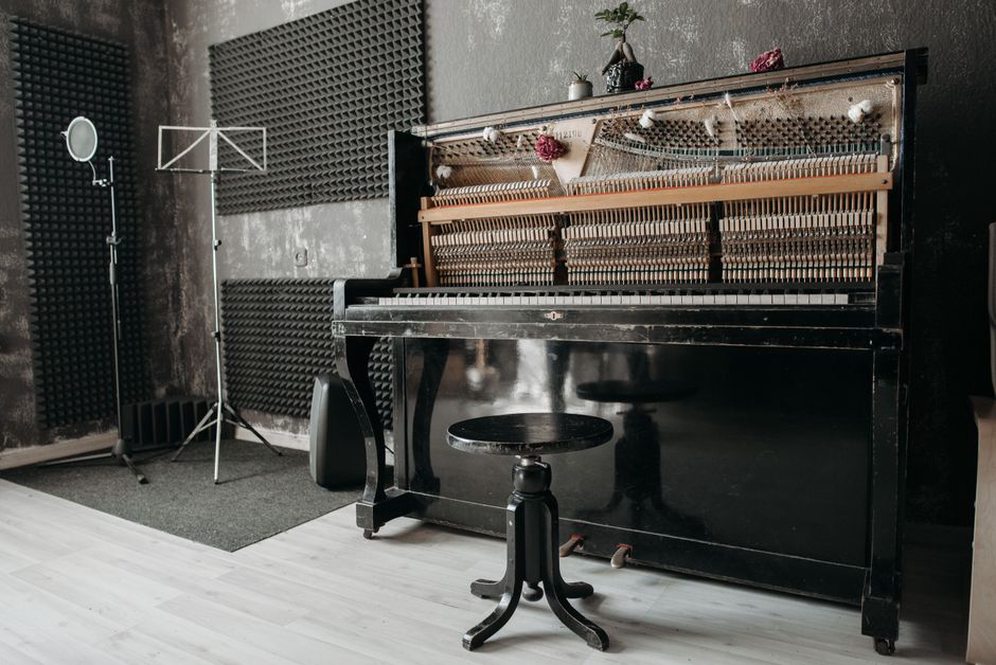
Minimal material can be tightly controlled. A sustained tone depends on tuning, gain staging, microphone placement, speaker response, and the behavior of the room. A field recording that appears untouched may be shaped by recorder placement, running time, what was excluded, and later editing. Sparse results are not evidence of little effort.
Duration changes the meaning of an event
A one-second scrape may register as an accent in a busy piece. Across a quiet ten-minute span, its grain, decay, and relation to the surrounding noise floor become the material. This is why drone and near-silent work ask for a different sense of time. The listener is not simply waiting for the next event; they are following shifts in pitch, texture, position, or pressure within the event already present.
Long durations also reveal the instability of sounds that initially seem fixed. A sine tone can beat against another frequency. A feedback loop can drift as temperature or body position changes. A bowed string’s sustained note contains changing friction. Room tone changes when a train passes, weather moves through a building, or a performer adjusts their posture. Minimalism can make such instability legible without forcing it into dramatic gesture.
Limits create audible relationships
Restricting an instrument or process puts pressure on small choices. An artist working with one contact microphone, one speaker, and a short feedback path has a tightly bounded system. Changes in angle, proximity, gain, and touch can yield radically different results. The limitation is not decorative austerity; it makes cause and effect available to the ear.
- Source limitation: one object, one oscillator, a single tape loop, or a fixed environmental location.
- Dynamic limitation: keeping a work within a narrow loudness range so transient detail carries weight.
- Temporal limitation: allowing a process to unfold without conventional peaks or resolution.
- Spatial limitation: using a close microphone, a fixed speaker placement, or a defined architectural site.
- Editorial limitation: retaining long sections rather than cutting every pause, handling noise, or accidental interruption.
Limits can be productive, but they do not guarantee depth. A sparse recording can still be inattentive, and an extended quiet section can become inert. Strong work establishes an audible relationship between material and duration. Even when little “happens,” there is a reason to stay with what is there.
Paths through Japanese experimental practice
Japanese explorations of minimal sound cannot be contained within one scene or institutional history. Contemporary music, improvised music, sound art, and underground recording cultures have often overlapped while retaining different priorities. Some work emphasizes notation and acoustic precision; other pieces emerge from performance situations, domestic recording spaces, or small-run physical formats. These routes meet in their attention to detail, but they are not interchangeable.
Takehisa Kosugi, associated with Fluxus and later the Taj Mahal Travellers, developed event scores and performance ideas that could direct attention toward simple actions, environmental conditions, and unstable sound. His importance does not lie in providing a tidy origin story. Rather, his work shows how a minimal instruction can open a wide field of listening and interpretation.
Toshi Ichiyanagi also worked through experimental composition, incorporating indeterminacy and unconventional relationships among performers, notation, and sound. Such practices show that reduction can operate through instructions and social organization, not only through austere recordings.
In a different register, Akio Suzuki’s work has made listening, movement, resonance, and site-specific action central concerns. His activities across performance and sound installation suggest that minimal sound is not always best encountered as a fixed album. Architectural setting, a listener’s route, and the timing of an action can all be structural elements.
On record, Sachiko M’s sine-wave-based work offers a precise example of reduction. Her use of pure tones and small-scale events redirects attention away from instrumental virtuosity and toward interference, audibility, and bodily perception. At certain frequencies and levels, a sound can seem to hover between tone, pressure, and the uncertain edge of hearing. Playback requires care: raise the volume gradually rather than treating it as a test of endurance.
Ryoji Ikeda’s sound practice, often associated with data, frequency, and audiovisual presentation, offers another example of minimal means producing intense perceptual effects. High-frequency material and sharply defined pulses can make hearing feel measurable, fragile, or physically contingent. This is not the same as quietness, but it shares a concern with thresholds: what can be perceived, what becomes painful, and what disappears.
Field recordings: restraint does not erase responsibility
A field recording may be quiet because the recorder was placed far from its subject, because the setting has long periods of low activity, or because the recordist chose not to foreground identifiable events. Environmental sound is never neutral raw material, though. A location has residents, workers, rules, and histories. A recording can expose conversations, routines, or vulnerable people who never agreed to appear on a release.
For work built around low-level environmental sound, ethical choices matter all the more because details may become clear through repeated listening. A distant voice that seems anonymous at first may be recognizable to someone who knows the place. Calling a recording “ambient” does not resolve the issue. Context, permission, editing, and the removal of sensitive material remain part of the work.
A practical listening setup for near-silent recordings
Minimal works are easily misheard through noisy playback chains or careless volume habits. A dedicated listening room is unnecessary, but a few adjustments can help separate recorded detail from the conditions around it.
- Start at a moderate-low level. Give the work several minutes before raising the volume. Sudden high gain can make low-level electronic noise and unexpected transients fatiguing.
- Use stable headphones or speakers. Closed headphones can reveal fine detail, but may amplify bodily sounds and cable noise. Speakers preserve room interaction, but introduce ambient interference.
- Reduce competing signals. Pause notifications, quiet computer fans where possible, and remove other sounds that mask low-level material.
- Track changes rather than events. Listen for shifts in brightness, beat frequencies, distance, reverberation, or background texture.
- Take breaks. Concentrated listening can feel physically demanding, especially with high tones or sustained frequencies.
Silence also changes the social setting of listening. A noisy work can take over a room and announce itself immediately; a minimal work may depend on the conditions around it. Playing a nearly silent recording in a shared space makes other people’s ordinary sounds part of the experience, whether they agreed to that role or not. In such cases, headphones can be a matter of courtesy rather than fidelity.
Media, circulation, and the evidence of small editions
Cassettes, CD-Rs, handmade packaging, and digital files have all supported Japanese underground experimental music, but format should not be romanticized. Tape hiss, uneven duplication, and physical scarcity may complement a low-level recording, yet they can also conceal detail or complicate preservation. A cassette has mechanical limits; it is not automatic proof of intimacy or authenticity.
For collectors, minimalist recordings present a particular archival problem. Sparse works can be hard to identify when titles are incomplete, files have been separated from artwork, or the only surviving document is a low-resolution recording. Do not infer an artist, date, or label from mood, filename style, or resemblance to known material. Attribution needs modest but concrete evidence: a catalogue number, a photographed insert, a verified listing, correspondence, or a reliable contemporary document.
This is especially relevant to anonymous and damaged files circulating through noise and experimental archives. Our examination of the “wasted finalver520 2” relic of Japanese noise is a reminder that an evocative fragment is not necessarily a fully identified release. Minimal sound can make the urge to project a story onto weak evidence even stronger.
| Listening element | What to attend to | Common misreading |
|---|---|---|
| Room tone | Its spectrum, consistency, and interruptions | Assuming it is accidental silence |
| Feedback | Pitch drift, resonance, and performer control | Hearing it only as equipment malfunction |
| Tape hiss | Whether it masks, frames, or changes the signal | Treating it as inherently atmospheric |
| Long pauses | How they alter expectation and memory | Assuming nothing is being composed |
| High frequencies | Audibility, discomfort, and speaker limitations | Equating intensity with volume alone |
Against the mythology of Japanese quiet
Minimal sound from Japan is often described through broad ideas of serenity, restraint, or timeless contemplation. Such labels flatten differences in class, technology, urban sound, institutional access, and artistic intention. They also obscure how abrasive, humorous, analytical, or physically demanding sparse work can be. A sine wave is not inherently meditative. A long environmental recording is not automatically peaceful. Silence can carry tension, exclusion, surveillance, exhaustion, or unresolved technical failure.
A more useful approach is to describe what is audible and how it is organized. Which frequencies persist? Does the sound come from a room, an instrument, a playback device, or an uncertain combination? Are edits hidden or exposed? Does duration produce attention, frustration, anticipation, or all three? These questions preserve specificity without forcing a work into a cultural script.
For musicians working with reduction, basic documentation may be more useful than a grand concept: source materials, recording location where appropriate, processing steps, dates, and whether a work is edited or continuous. A listener returning to a twenty-minute recording of a single low drone can compare its opening, midpoint, and ending for changes in beating patterns, distortion, and room response, rather than relying on the claim that the piece is “about silence.”