
The kitchen floor can look bright while the chopping board sits in shadow. Stand at the counter after dark and see where the shadow falls. If the ceiling light is behind you, a brighter bulb will still leave you standing between the light and the board. A shielded light under the upper cabinet goes straight to the problem.
Use the same test elsewhere. Sit where you read liner notes, stand where you sort cassettes, and look into the bathroom mirror. What matters is what you can see from the spot where you actually use the light.
Choose the light’s position before choosing a bulb
Ambient light lets you see what’s in a room and move around it. Task light puts light on a workbench, a page, or another surface you’re using. Accent light draws the eye to something like a record sleeve or a textured wall. These terms describe what a fixture does, not what kind it is. A floor lamp aimed at the ceiling can light the room; an adjustable one beside a chair can light a page. Two lamps may be enough in a small room if you can switch them on separately.
Before buying a fixture, try an existing lamp in the spot you have in mind. Look once after dark and again when daylight is strongest. Sit or stand as you normally would and check for glare, both from the bulb itself and in screens, glossy sleeves, mirrors, and worktops. A bare bulb you barely notice from the doorway might be all you can see once you sit down. Try shifting the lamp sideways or changing the shade before reaching for a dimmer bulb.
What the bulb label can tell you
- Lumens tell you how much light a bulb puts out. Watts tell you how much power it uses. Around 800 lumens is a starting point for replacing a traditional 60-watt incandescent, but the number won’t tell you how the light will fall on a table. A narrow beam concentrates it, while a diffuser spreads it. Dark walls reflect less light back into the room, and dark shades can limit how much reaches it in the first place.
- Kelvin tells you how warm or cool the white light looks. At 2700 K, the light has a warm cast that often suits bedrooms and listening spaces. At 3000 K, it’s still warm but less amber. If you prefer a more neutral white at a workbench, try something around 3500–4000 K. Keep neighboring fixtures close in color unless you want to see the contrast.
- Color rendering matters when you’re comparing materials. A color rendering index (CRI) of 90 or higher is a useful starting point for looking at artwork, telling wire colors apart, or checking printed inserts. The number only goes so far, especially with saturated reds. If color matters, bring a familiar sleeve or a sample of the material and look at it under the lamp itself.
- A dimmable bulb still needs a compatible control. If you use a wall dimmer, check that it works with the LED you’re buying. Some pairings flicker, buzz, or cut out near the bottom of the range. Test the lamp at the low setting you’ll actually use, not just at full brightness.
Living room and listening space: keep light out of the sightline
The light you want when people are talking may be more than you want when you sit down to listen. A shaded table lamp or a lamp aimed up at a pale wall can give you enough background light to find a seat. Put a separate lamp beside the chair if you read inserts or take notes there. At seated eye level, the shade should hide the bulb while leaving the page well lit. If a glossy insert catches the beam, try moving the lamp a little to one side before tilting the page.
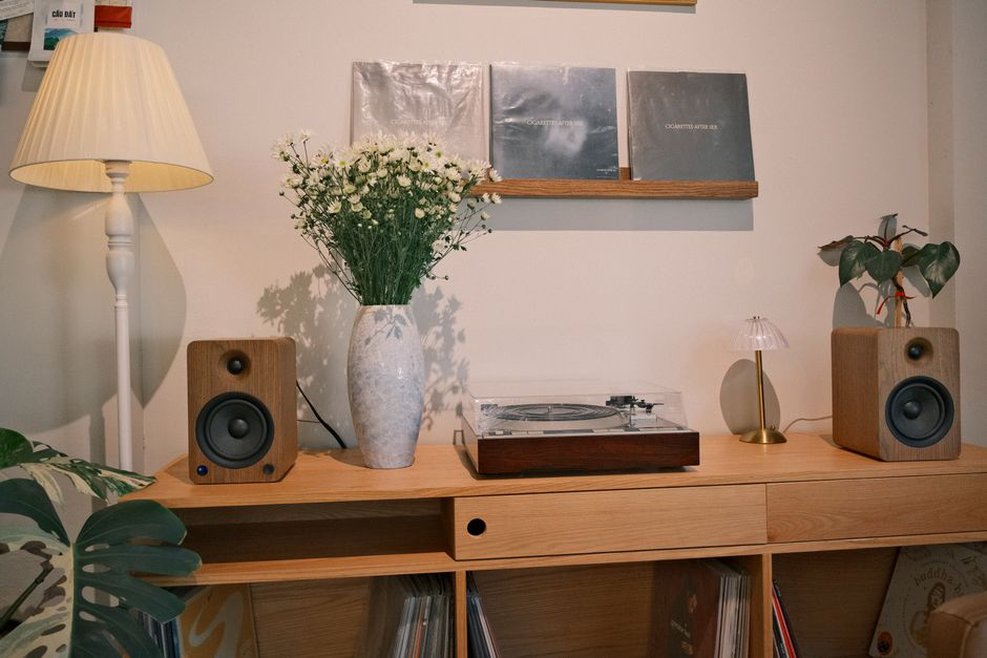
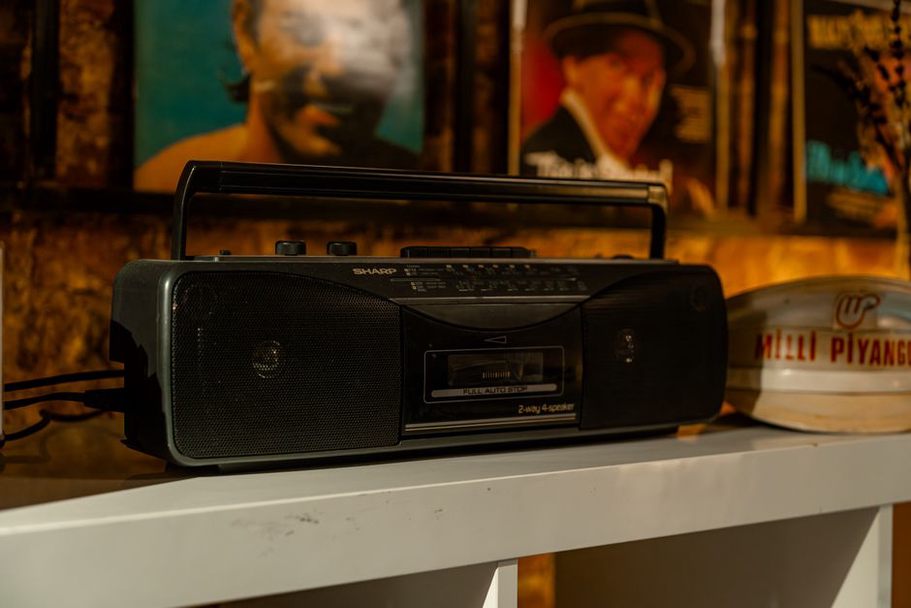
Look at the stereo from that seat, too. A low lamp across from a deck can show up in the meter window and make the scale harder to read. A shielded lamp beside the deck can pick out the transport buttons and cassette labels without lighting the whole wall.
Keep displayed paper sleeves out of direct sun. Even indirect display lighting adds to their exposure over time. Take originals down periodically, or hang reproductions where daylight is hard to control.
Kitchen and dining area: give the worktop and table their own light
Start where shadows get in the way: at the chopping board, the sink, and the stove. A diffused strip near the front edge of an upper cabinet puts more light on the counter and less on the backsplash. Check that you can’t see the strip from where you normally stand or sit, particularly across an open-plan room. On a polished counter, look for reflections of individual LEDs. A diffuser can soften those points, but if they’re still visible right where you work, shift the fixture. Without upper cabinets, position ceiling fixtures so the light reaches the counter from in front of you instead of over your shoulder.
At the dining table, look for a pendant that lights faces and plates without leaving a bright bulb in view across the table. Start at roughly 30–36 inches (76–91 cm) above the tabletop, then sit down and check before committing to that height. This matters with a shallow shade, especially if you also use the table to fold cassette inserts. Put the pendant and worktop lights on separate controls so you can dim the table at dinner and still see what you’re doing at the sink.
Bedroom: separate getting dressed, reading, and getting up at night
A ceiling fixture can light the bed and barely reach the clothes inside a wardrobe. A closet-rated fixture aimed at the clothes from the front is more useful than a bulb behind the hanging rail. Follow the fixture’s clearance requirements for stored items, and put the control somewhere you can reach with the door open. For a shared bed, adjustable lamps with opaque shades let either person read without lighting up the other pillow.
A low, shielded light along the route to the door can pick out shoes and thresholds without putting a ceiling light in your eyes. If it’s on a motion sensor, test it from the bed as well as the doorway. It should come on when someone gets up, not when a foot moves under the covers. Keep the brighter light easy to switch on when you need to change the bedding, clean, or find something small on the floor.
Bathroom: light the face from the front
A downlight directly above the mirror can deepen the shadows around your eyes and under your chin. Diffused lights on either side of the mirror, close to face height where possible, fill those shadows more evenly. On a narrow wall, a broad, diffused fixture just above the mirror works better than a small spotlight high on the ceiling. Check it at the eye level of everyone who uses the mirror. A bright edge a taller person never sees may be right in a shorter person’s line of sight.
Choose shower and tub fixtures separately. The right rating depends on where the fixture goes and what it’s exposed to. A damp-location rating is not a substitute for a wet-location rating where direct spray is possible. Local rules may also limit fixture types and placement around baths and showers. Ask a qualified electrician to confirm that the fixture and installation are suitable for that zone.
Desk, tape bench, and recording corner: aim for a clear work surface
Put a desk lamp on the side opposite your writing hand so your hand doesn’t cast a shadow over a field recorder’s card label or a handwritten track note. At a tape bench, an articulated lamp can cast a broad pool of light for sorting cases, then tilt low to reveal dust or scratches. Try both angles on a clear cassette shell. A beam aimed straight down can turn the plastic into a mirror.
Set a lamp low or off to one side so you don’t see it reflected in the computer screen. A window beside the desk is often easier to work with than one directly behind you or directly behind the monitor. If the screen looks harsh against a dark room, try a little diffuse light on the wall behind it rather than another bright object on the desk.
Before filming a small performance or documenting a tape repair, shoot a short clip with the dimmer and camera set the way you’ll use them. Some LEDs look steady in person but show up as moving bands on camera.
Hallways and stairs: check the route in both directions
A bright landing doesn’t tell you much about how well you can see the bottom steps. Walk the route both ways. Check for treads that disappear into shadow and fixtures that shine into your eyes on the way up. Shielded wall lights or fixtures that spread light across the steps can make the edges visible without leaving the landing glaringly bright. If there are switches at both ends, try them from both landings. A sensor should pick up your approach before the first step and keep the lights on even if you take the stairs slowly.
Test one change before committing to the rest
When replacing a bulb, check the base, the bulb’s size, and the fixture’s limits. If the bulb will sit behind a closed globe, make sure it’s approved for enclosed fixtures. In a rental, a plug-in lamp gives you another light source without changing the wiring. Run the cord along the wall, not across a doorway or under a rug. Have a qualified electrician assess any new fixed fixtures or controls.
Try this in a combined living and listening room before spending anything: move a shaded lamp beside your chair and turn off the ceiling light. Read the smallest type on a cassette insert, then look at the deck display without getting up. If the print is clear but you can see the shade reflected in the display, nudge the lamp sideways a little at a time. You may be able to move the reflection out of sight without losing any of the light on the page.