
A recording of a station platform is not automatically a document of transit. A microphone may isolate an escalator motor, compress an announcement into an unreadable rhythm, or leave a long stretch in which nothing conventionally dramatic happens. In Japanese experimental practice, the force of field recording often lies in such choices: where the recorder sits, how long it runs, what is excluded, and how the result is presented for listening.
“Japanese field recording” is too often used as a genre label, or as proof of some supposedly timeless closeness to nature. Neither idea is especially helpful. Artists working in Japan have recorded forests, shorelines, apartment interiors, industrial sites, streets, temples, rail corridors, and electronic devices, yet location alone does not create meaning. Field recording becomes art through attention, editing, context, and the ethical relationship between recorder, place, and listener.
From captured environment to composed listening
Field recording generally refers to sound made outside a controlled studio: weather, animals, machinery, voices, public spaces, domestic ambience, or other events encountered in situ. The boundary is porous, though. A contact microphone on a bridge, a hydrophone in water, or a recording made through a window each changes what counts as “the field.”
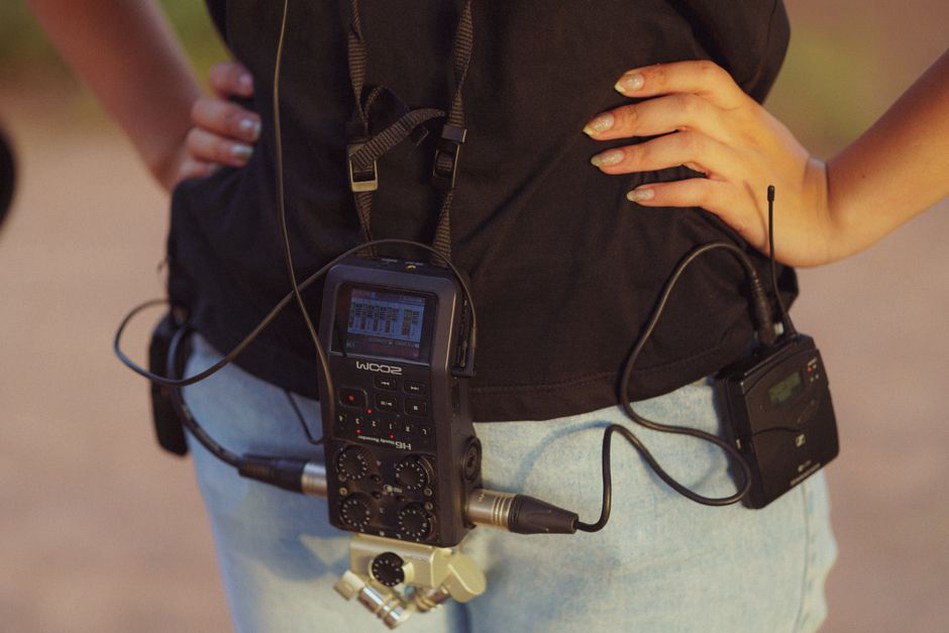
The recorder is not neutral. Microphones have directionality, noise floors, frequency responses, and handling artifacts. Every technical decision produces a version of a place, not the place itself.
Japanese sound art and experimental music contain several overlapping approaches. Some works preserve recognizable environments and ask for extended, close listening. Others obscure their sources through processing, montage, repetition, or unusually selective recording. A cicada chorus can become a dense high-frequency texture; a refrigerator hum can function as drone; a brief piece of street noise can become percussion. The aim is not necessarily to erase the source, but to unsettle its ordinary role.

Akio Suzuki is a useful reference point for thinking of listening as an artistic act rather than simple collection. Across his work, walking, resonance, found objects, and site-specific attention remain central. Sound is not treated as scenic background. Environments appear as situations shaped by bodies, materials, architecture, and movement. Recording, in this sense, may be only one part of a broader investigation of place.
Work linked to musique concrète, electroacoustic composition, and sound installation has further blurred the distinction between “found” and “made” sound. A recording may be presented with little intervention, heavily altered in a studio, or used as part of a performance. Rather than asking whether a sound is authentic, it is often more useful to ask what kind of attention the work asks of the listener.
Place is not a postcard
Nature recordings circulate widely in ambient and experimental music, including releases from Japan. Rain, wind, insects, water, and birds can easily suggest calm or immersion. That expectation can hide the material complexity of real environments. A coastal recording may include engines and construction; a mountain path may carry aircraft, voices, and road noise; a residential garden may be dominated by ventilation systems. These interruptions are not necessarily flaws. They can reveal how places are shared, maintained, and altered.
Urban recordings need the same patience. Tokyo, Osaka, Kyoto, Sapporo, and smaller cities are often reduced to a narrow set of audible signs: crossings, trains, crowds, vending machines, announcements. Those sounds can be compelling, but they can also become shorthand. A more exacting practice listens for shifting acoustic zones: reverberation beneath a pedestrian overpass, kitchen extraction fans behind a shopping street, delivery vehicles before opening hours, or the muffled atmosphere of an office corridor after dark.
Specificity matters. A title that names a location can imply documentary authority even when the recording has been heavily edited or materially altered. Alteration is not the problem. The issue arises when a work uses place as exotic evidence while hiding its own construction. Notes do not need to become technical paperwork, but basic details about source material, dates or seasons where relevant, processing, and recording conditions help listeners understand what they are hearing.
For a related discussion of how environmental sound and noise complicate each other, see the connection between noise and nature in Japanese experimental music.
Three artistic strategies in field-based work
Duration: letting a sound disclose itself
Long takes resist the demand for an immediate event. Over several minutes, an apparently static recording may reveal unstable layers: wind pressure shifts, birds change distance, traffic pulses through gaps, room tone develops a low-frequency rhythm. Duration is not automatically meaningful, however. It works when the recording contains enough detail, or when the artist’s restraint lets the listener notice change at a believable pace.
Framing: making an edge audible
A field recording has edges in time and space. Starting just before a train arrives, rather than at its loudest moment, changes the sense of anticipation. Recording behind a wall makes the wall part of the composition. Leaving in footsteps, cable movement, or a recorder’s self-noise can acknowledge the maker’s presence instead of pretending to offer disembodied access to a site.
Transformation: treating source as material
Processing can magnify what a recording conceals. Equalization may bring forward electrical hum; time-stretching can turn a brief metallic event into an extended mass; filtering can make speech unreadable while retaining its cadence. These methods are common in ambient, noise, and electroacoustic work, but they require judgment. Processing is most convincing when it draws out tensions already present in the source rather than applying a generic atmospheric finish.
| Approach | What it emphasizes | Common risk |
|---|---|---|
| Unedited or lightly edited take | Duration, spatial perspective, contingency | Assuming rawness guarantees significance |
| Montage | Contrast, rhythm, relations between places | Creating a false sense of continuity or documentary fact |
| Heavy processing | Texture, hidden frequencies, abstraction | Losing all trace of why the source mattered |
| Site-responsive performance | Acoustics, audience position, material resonance | Documentation that cannot convey the live spatial experience |
Listening without treating sound as evidence
Field recordings can feel unusually truthful because they preserve traces of events that occurred somewhere. Yet they are never transparent evidence. Microphone placement changes scale and distance; editing changes sequence; a stereo recording can produce a spatial image very different from embodied hearing. Even an apparently untouched take begins with a decision to press record and ends with a decision to stop.
That does not make field recording deceptive. Like photography, cinema, and other documentary forms, it is a situated representation shaped by formal choices. The richest listening holds both facts at once: a recording may reveal something about an environment while remaining an object whose rhythm, density, silence, and perspective deserve attention in their own right.
This is especially useful for works that sit between environmental recording and noise. A harsh passage may be close-miked mechanical activity rather than synthesized feedback. A soft wash of sound may be digitally altered city ambience. Resisting quick genre assumptions makes the material easier to hear. The same applies to silence: low volume is not absence. It may contain distant infrastructure, room resonance, weather, or the limits of the recording system.
Ethics before access
Recording in public does not remove ethical obligations. Conversations may remain intelligible even when they seem incidental; people may reasonably object to their voices appearing on a release. Sensitive locations, ceremonial settings, workplaces, private residences, and ecologically fragile areas call for particular care. Permission is not a bureaucratic annoyance. It recognizes that access is relational.
- Do not record people as anonymous texture when speech is identifiable or potentially sensitive.
- Ask before recording in semi-private spaces, including small businesses, galleries, venues, and shared residential areas.
- Avoid disturbing wildlife in pursuit of close or “clean” recordings; distance and patience are often better tools.
- Keep contextual notes on location, time, weather, equipment, and intervention, especially when sounds may later be misidentified.
- Consider what publication changes: a sound heard locally can have different consequences once distributed internationally.
These principles matter in DIY settings as much as institutional ones. A cassette, small-run CD-R, download, or private archive may travel far beyond its first audience. Documentation is part of the work’s care structure: it can preserve uncertainty, acknowledge collaborators, and keep a source from being detached from its circumstances.
A practical method for musicians and collectors
For musicians, a useful exercise is to record one familiar place on three separate days without trying to capture a highlight. Use the same position each time, note the conditions, and listen back at low volume on headphones. Mark recurring events, accidental interruptions, and changes that emerge only through repetition. The result has an internal history rather than a single decorative atmosphere.
Collectors can treat liner notes and credits as listening tools. Notice whether a work identifies source locations broadly or precisely, distinguishes live capture from studio treatment, and makes claims its audio can support. Sparse information is not automatically evasive; some artists deliberately retain ambiguity. Still, the difference between mystery and vague branding is often audible in the care given to sequencing and sound perspective.
When editing a first piece, begin with one unprocessed take and make a single intervention: remove a section, adjust the level, or place a second recording beside it. Export both versions and compare the transitions instead of chasing a grand effect. A clean cut between incompatible ambiences can say more about distance, memory, or infrastructure than effects applied indiscriminately to every second of sound.