
A hand inside a wash tub means hand wash. Put an X across the tub and the instruction changes to do not wash. On a tiny, faded label, that difference is easy to miss. Before cleaning a garment, check the full set of symbols: washing, bleaching, drying, ironing and professional cleaning.
Five shapes do most of the work. The tub covers washing, the triangle bleach, the square drying, the iron pressing and the circle professional cleaning. Marks inside or beneath them add limits: a cross rules out a method, dots usually indicate heat, and bars call for gentler handling. Designs vary by region and brand, so the garment’s own label matters more than a general rule about its fibre.
Washing symbols: the tub
A plain tub permits washing. A number inside gives the maximum water temperature in degrees Celsius, not the temperature you must use: a 40°C label allows 40°C or cooler, as long as the cooler wash cleans the item adequately. Some labels use dots instead—one for cool, two for warm and three for hot. If a number is printed, follow that rather than a general description of the heat.
| Mark on the wash tub | What it means | Practical response |
|---|---|---|
| Plain tub | Machine washing is permitted | Check separate drying and ironing limits |
| 30, 40 or 60 | Maximum wash temperature in °C | Choose that temperature or lower |
| One line beneath | Mild or permanent-press process | Use a gentler cycle; do not overload the machine |
| Two lines beneath | Very mild or delicate process | Use a delicate cycle with reduced agitation |
| Hand in tub | Hand wash | Wash gently, without scrubbing or wringing |
| Crossed-out tub | Do not wash | Check the professional-cleaning symbol |
The bars beneath a tub are easy to overlook. They limit mechanical action; they do not raise the permitted temperature. A 40°C tub with two bars means no hotter than 40°C and a very mild wash. If your machine has several delicate settings, pick one with gentle movement and a restrained spin. An unlined tub, meanwhile, gives no special mild-process instruction—it is not a reason to wash the item harshly.
For hand washing, stay within any temperature limit shown and move the garment gently through the water. Support heavy or loosely knitted fabric when you lift it, then press out water instead of twisting. A crossed-out tub is stricter than a hand-wash mark: washing has not been approved, even by hand.
Bleaching symbols: the triangle
A plain triangle permits bleach when needed. A crossed-out triangle means do not bleach, though the garment may still be washable. Two diagonal lines inside the triangle allow non-chlorine bleach only. Some labels use a crossed-out triangle containing the letters CL to say, more specifically, no chlorine bleach. Check which mark you have before using a bleaching product.
Permission is not a recommendation to bleach every load. Follow the product instructions and test colourfastness where appropriate. If the label prohibits bleach, check for bleaching additives in the detergent when they matter for the garment’s fabric or finish.
Drying symbols: squares, circles and lines
Drying instructions begin with a square. A circle inside the square means tumble drying; an X across that combined symbol rules it out, even if machine washing is allowed. A tumble-dry symbol without dots permits normal tumble drying under that label system. One dot calls for low heat, while two mean normal or medium heat. Machines and labels do not always use the same terms, so choose the lower setting if the match is unclear.
Lines inside a square describe drying without a tumble dryer:
- One vertical line: line dry, for example on a clothesline.
- Two or three vertical lines: drip dry, with less water removed before hanging.
- One horizontal line: dry flat.
- Two or three horizontal lines: drip dry flat.
- Diagonal line in a corner: dry in the shade; it may appear alongside a line-dry or flat-dry mark.
Hanging versus drying flat can make a bigger difference than a small change in wash temperature. A wet knit may stretch under its own weight; laid flat, it has a better chance of keeping its shape. A drip-dry instruction, on the other hand, may mean hanging the garment while it is still wet instead of putting it through a forceful spin. For flat drying, lay the item in its intended shape on a suitable surface rather than folding it over a rail, where it may stretch or dry unevenly.
A crossed-out square on its own can mean do not dry in some symbol systems, though the mark is uncommon and hard to interpret without the rest of the label. Look for accompanying words or drying marks before assuming it rules out every way of removing moisture. A crossed-out tumble-dry symbol has a clearer meaning: keep the garment out of the machine dryer.
Ironing symbols: the iron and its dots
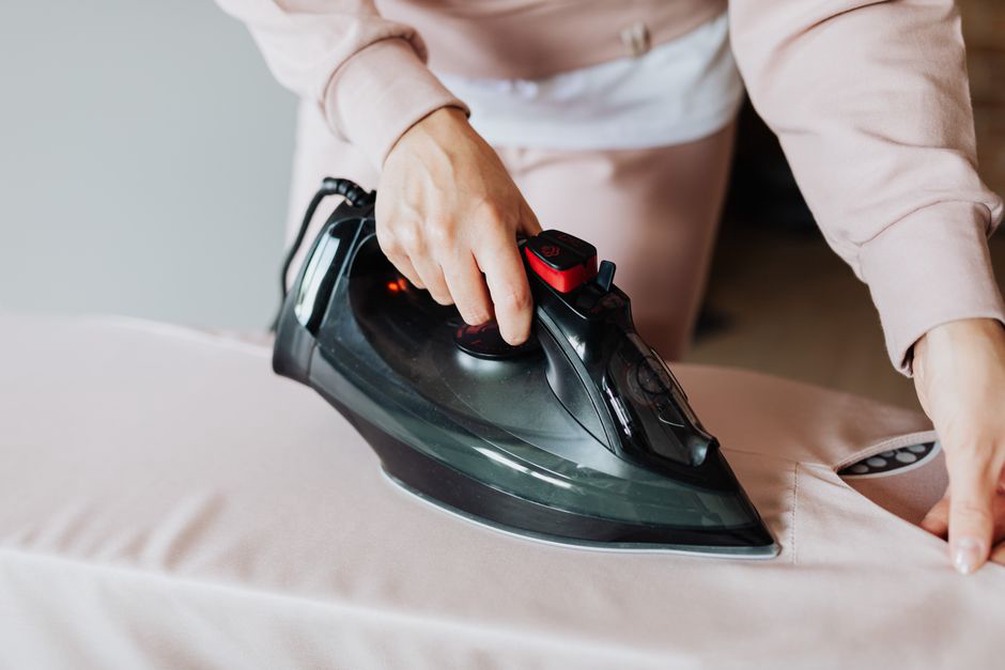
An iron outline permits ironing. Dots set the maximum soleplate heat: one dot means low, two mean medium and three mean high. Many irons use matching dots on their controls. A crossed-out iron means do not iron—not “iron on low.”
An iron with crossed-out steam lines beneath it may still permit ironing, but not steam. Check that restriction separately from the soleplate temperature. Excess heat can damage some fabrics and finishes; a pressing cloth may help where appropriate, but it does not raise the label’s heat limit.
Drying and ironing limits also stand separately. “Do not tumble dry” does not necessarily mean “do not iron,” and a three-dot iron does not cancel a low-temperature wash instruction.
Professional-cleaning symbols: the circle
A plain circle refers to professional cleaning, not a cycle on a home washing machine. Letters inside specify processes and solvents for the cleaner: common marks include P and F for types of professional dry cleaning, and W for professional wet cleaning. They are instructions for the cleaner’s equipment and expertise, not directions to apply a solvent at home.
One bar beneath the circle requests a milder process; two indicate a very mild process where that notation is used. A crossed-out circle means do not dry clean. If the crossed-out circle contains W, it means do not professionally wet clean. A restriction on one process does not automatically ban the others.
Take “dry clean only” seriously, particularly on lined, structured or embellished clothing. The outer fabric might tolerate water while its interfacing, lining, dyes or trims do not. If words and symbols seem to conflict, ask a professional cleaner before trying anything. Bring a valuable or fragile garment in rather than describing one symbol over the phone: its construction and stains may affect the treatment.
How to read several symbols on one label
Care symbols cover successive stages, but they are not one combined command. A 30°C tub with two bars, a crossed-out triangle, a crossed-out tumble-dry square and a one-dot iron means wash at no more than 30°C on a very mild cycle; do not bleach or tumble dry; and iron on low heat if needed. Ironing is not compulsory. If the label also says to dry flat, do that after washing.
For a mixed load, follow the most restrictive relevant instruction. A towel that can take a hot wash does not make that wash safe for a 30°C shirt. Rougher items can damage a delicate garment even at the right water temperature. Separate clothes when their heat, agitation or drying needs differ. A laundry bag may reduce snagging, but it cannot make a normal cycle equivalent to the very mild process indicated by two bars.
The limits apply to the whole item, not only its main fabric. A print, bonded seam, elastic, trim or lining may need less heat than the outer material suggests. Cotton often tolerates heat, for instance, but a particular cotton garment may have a lower limit because of its construction or finish. Fibre content alone is not enough to go on.
When the label is faded, missing or confusing
Start with whatever remains readable, including words or a second label. Check whether a mark disappears into a seam before reading it as a complete symbol. The other piece of a matching set may offer a clue, though its materials or construction may differ. Treat a clue as a clue, not a firm instruction.
If the care information is gone, a cool, gentle wash may be a cautious first attempt for a washable-looking, unstructured item—after testing an inconspicuous area for colour transfer. It is no guarantee. Leather, suede, structured jackets, embellishments and unstable dyes may warrant specialist advice. Avoid heat until you know how the garment responds: shrinkage, distortion and print damage may be irreversible. For a stain, work out what caused it before choosing a treatment; rubbing an unknown mark can push it deeper into the cloth.
Regional designs can differ, particularly for natural drying and older bleach instructions. Read the shape first, then any marks inside it and bars beneath it. If the print is too small, photograph and enlarge the label. On a blurry drying mark, look closely for the circle inside the square and for an X across it: one dot in that square-and-circle symbol permits low-heat tumble drying; an X means keep the garment out of the dryer.