
When Hanatarash brought power tools and heavy machinery into their 1980s performances, the disturbance reached beyond sound. The group, led by Yamatsuka Eye, unsettled the basic terms of a concert: where could the audience stand, and where did the performance end? Those events loom large in accounts of Japanese noise, but they are no model for the genre as a whole. Incapacitants could produce comparable intensity with amplified electronics, without turning the room into a demolition site. That difference matters if “avant-garde” is to mean more than loudness or spectacle.
Japanese noise took shape through free improvisation, experimental rock, performance art, electronic composition, mail exchange and small-scale publishing. Its avant-garde connections are historical as well as aesthetic. Musicians inherited questions about the line between art and ordinary sound, then put them to work with distortion pedals, tape decks, feedback loops and the social rules of a live show.
What the avant-garde connection does—and does not—explain
“Avant-garde” names no single musical style. In twentieth-century art, it often described work that challenged established forms, institutions or distinctions between art and life. For a noise musician, that could mean refusing conventional pitch and rhythm. It could also mean making the venue, the recording format or the audience’s response part of the work. None of this automatically makes a performance politically radical. An abrasive record can become a collectible commodity, while a quiet improvisation may unsettle stronger assumptions about what a musician is supposed to do.
Prewar Japanese experimental art, postwar avant-garde movements and the noise scenes that gained international visibility in the 1980s and 1990s are not one continuous school. The Gutai Art Association, founded in 1954, pursued material experimentation across painting and performance. It offers a useful comparison, not a direct explanation for every later musician’s methods. The Encyclopaedia Britannica’s account of Gutai provides background on the movement; an interest in action and materials does not establish that a noise artist belonged to it or drew directly from it.
Closer precedents included Japanese free improvisation, underground rock and experimental performance of the late 1960s and 1970s. Influence also arrived from elsewhere. Records, radio, touring and correspondence brought musicians into contact with international electronic music, free jazz, industrial music and punk. Calling the result uniquely Japanese obscures those exchanges—and the differences among artists working in Japan.
From free improvisation to amplified noise
Guitarist Masayuki Takayanagi is an important reference point in Japanese free improvisation. His aggressive use of volume and density showed how amplified instruments could be pushed against their familiar roles. Later noise was not simply an extension of his playing: an improvised guitar ensemble and a solo set built from electronic feedback organize sound differently. What connects them is the treatment of intensity as a compositional problem.
Keiji Haino makes any neat family tree harder to draw. In solo work and projects including Fushitsusha, he has moved between voice, guitar, percussion and other instruments. His performances can be punishingly loud, yet pauses, repetition and exposed gestures can matter just as much. To file all of it under “noise” misses its ties to rock performance and free improvisation. The avant-garde impulse here is not a rejection of feeling or form, but an unwillingness to accept one inherited form as the right container for either.
By the 1980s, artists associated with the loosely defined Japanoise label had made electronic saturation especially visible. Masami Akita’s Merzbow project explored dense layers of distortion and feedback through changing equipment and recording practices. Incapacitants—the duo of Toshiji Mikawa and Fumio Kosakai—became known for highly physical electronic performances. These are distinct bodies of work, not interchangeable examples of maximum volume.
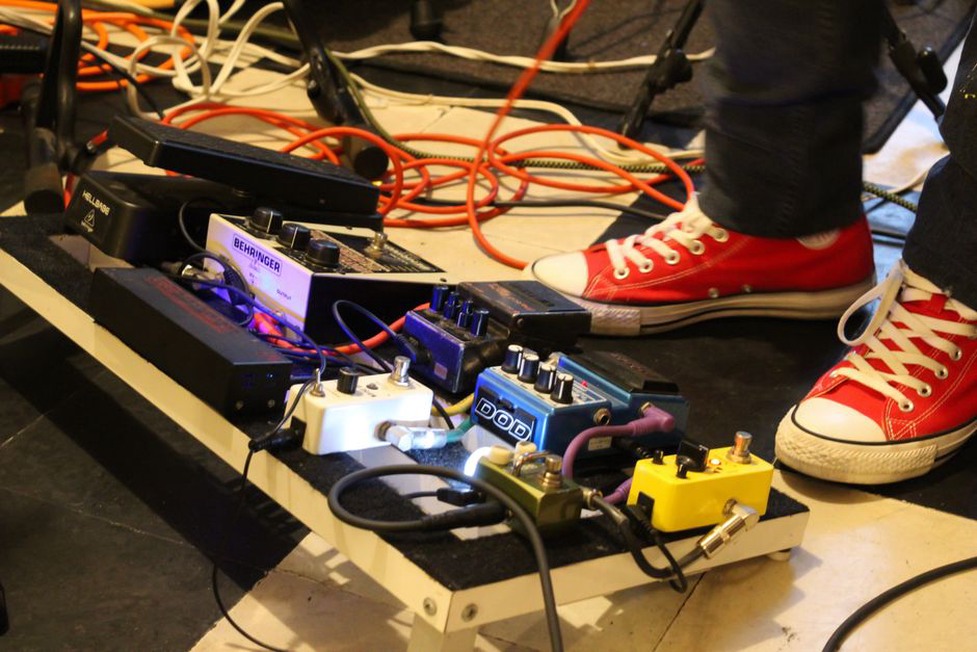
Three different ways sound can resist convention
- Material resistance: feedback, overload and mechanical vibration expose the behavior of equipment usually expected to carry a clean signal.
- Formal resistance: a set may offer no stable beat, refrain or familiar pattern of development to orient the listener.
- Social resistance: a performance may disturb expectations about virtuosity, audience distance or how long attention should be sustained.
These approaches sometimes coincide, but they need not. A meticulously edited noise record can be tightly controlled in form. A guitarist playing recognizable notes may challenge performance conventions more sharply than someone running a distortion pedal at full gain. The better question is which convention is being tested.
Performance art, danger and its limits
Hanatarash is hard to discuss without accounts of hazardous performances. They belong in the history, but sensational retellings can make danger the only thing anyone remembers. What those events changed was the contract between performer, venue and audience. Spectators at a concert usually have some confidence about the boundaries of the action. Hanatarash tested that confidence in ways that were not merely symbolic.
That history is no endorsement of unsafe practice, nor does noise require bodily risk. Most performances depend on ordinary constraints: electrical supply, room size, monitor placement and a performer’s ability to control a system prone to instability. Hearing protection is a practical consideration at high-volume shows. Loudness can alter perception; permanent hearing damage is not an artistic achievement.
Other artists worked through accumulation rather than confrontation. Hijokaidan, formed in 1979, developed a reputation for volatile live shows while building a substantial recorded history. Compare a live account with a record and “the work” becomes less easy to pin to a fixed sequence of sounds. A recording preserves a particular mix and duration; a performance distributes sound through a room, making the audience’s position consequential. Documentation can be valuable without being equivalent to attendance.
Records, tapes and the international label
The word Japanoise helped listeners abroad find related releases, but it suggests more unity than the music warrants. Merzbow’s extensive catalog, a Hijokaidan performance and a restrained piece of Japanese electroacoustic music share no single technique or purpose. The label works best as a clue to how recordings circulated and were grouped, not a rulebook for what Japanese experimental musicians made.
Cassettes, small labels, mail order and correspondence carried work with limited mainstream support to distant listeners. A cassette could be duplicated and sent without the infrastructure of a commercial record release. Those same conditions make research harder now. Reissues may alter track divisions or artwork, and an online file may have no reliable notes. Scarcity invites mythmaking. Compare the sleeve, label and track listing; distinguish an original release date from a reissue date; leave uncertain attributions uncertain.
DIY circulation did not simply bypass institutions. It built its own networks of trust, taste and exclusion. A small edition might travel through personal exchange yet remain out of reach for anyone outside that circle. International attention could preserve recordings and create opportunities for artists, but it could also favor the most spectacular work over less easily marketed music. The history of noise is partly about who got to hear it, name it and keep a copy.
Instrument-building offers another view of those networks. Modified electronics let performers work with unstable responses instead of preset tones. For a closer account of the tools and the people exchanging them, DIY synthesizers in Japan’s experimental music networks traces that practical side of the scene.
Where noise meets ambient, drone and electroacoustic work
The boundary between noise and its quieter neighbors is porous. A sustained electronic tone may sound like a drone until amplification brings its rough edges forward. A field recording may preserve the recognizable sound of a place, or be processed until its source is hard to identify. Electroacoustic work may rely on careful editing, while live noise often foregrounds the immediate response of a circuit or room. These are tendencies, not dependable genre tests.
A simple opposition between “noise” and “music” misses the decisions inside apparently chaotic work. Distortion can mask one layer while exposing another. A sudden cut to silence can bring a venue’s ventilation or the residual hum of equipment into focus. Quiet work, meanwhile, is not necessarily more contemplative or less confrontational. The question is which listening habits a piece asks us to reconsider, not where it sits on a volume scale.
A practical way into the recordings
Compare methods before reputations. Choose one Merzbow recording, an Incapacitants performance and a Keiji Haino or Fushitsusha recording. Notice whether each builds through layers, responsive gestures or recurring phrases. Then listen for changes of scale: does a new sound enter, does the whole texture shift, or does something previously buried become audible? It is more useful than ranking the works by how extreme they seem.
Playback conditions matter. Start at a moderate level, especially with recordings that stay dense for long stretches. If a passage seems featureless, lowering the volume may clarify its contours; turning it up is not the only way to hear more. Headphones expose close detail, while speakers reveal how low frequencies and distortion interact with a room. Neither reproduces a live event or supplies a definitive version.
For an unfamiliar release, note its format, credited performers and the date printed on your copy before assigning it a broad genre label. With a cassette, even the split between side A and side B may tell you more than the word “noise”: it determines where the recording stops, when you have to turn it over and what begins after that interruption.