
In Japanese ambient music, silence is rarely an empty interval waiting to be filled. It may hold room tone, tape hiss, the long decay of an electronic sound, the pressure of a sustained chord, or the deliberate choice not to introduce another event. This attention to duration is often explained through Zen, usually too quickly. Zen has shaped ideas about listening and artistic practice in Japan, but it is not a universal key for interpreting every quiet recording by a Japanese artist.
The more useful question is not whether a piece of ambient music “sounds Zen.” It is how particular practices—restraint, repetition, attention to ordinary materials, impermanence, and situated listening—enter the work. These practices may relate to Zen thought, broader Japanese aesthetic traditions, studio methods, or international experimental music. Keeping those threads separate lets the music speak more clearly on its own terms.
Zen as practice, not a sonic label
Zen Buddhism consists of religious traditions grounded in practices including seated meditation, ritual, study, and disciplined everyday activity. It is not a theory of genre, nor does it prescribe synthesizer pads, soft piano, rain recordings, or slow tempos. The common association between Zen and minimal, peaceful sound is partly a modern commercial shorthand. It can obscure the rigor, contradiction, physical labor, and institutional history of Zen communities.
For musicians, its influence is often indirect. A composer may be shaped by cultural conversations around ma—interval or spatial relation—the concentration involved in repeated action, an acceptance of unstable materials, or an encounter with temple architecture and ritual sound. None of this automatically makes a work Buddhist. These are ways of listening, not evidence of spiritual identity.
The distinction matters especially in ambient music, where sparse arrangements invite projection. A track with few notes may feel meditative because it gives the ear time to register change, not because it represents meditation. Music made by a Zen practitioner, meanwhile, may be abrasive, dense, or deliberately unsettling.
Space, interval, and the active role of absence
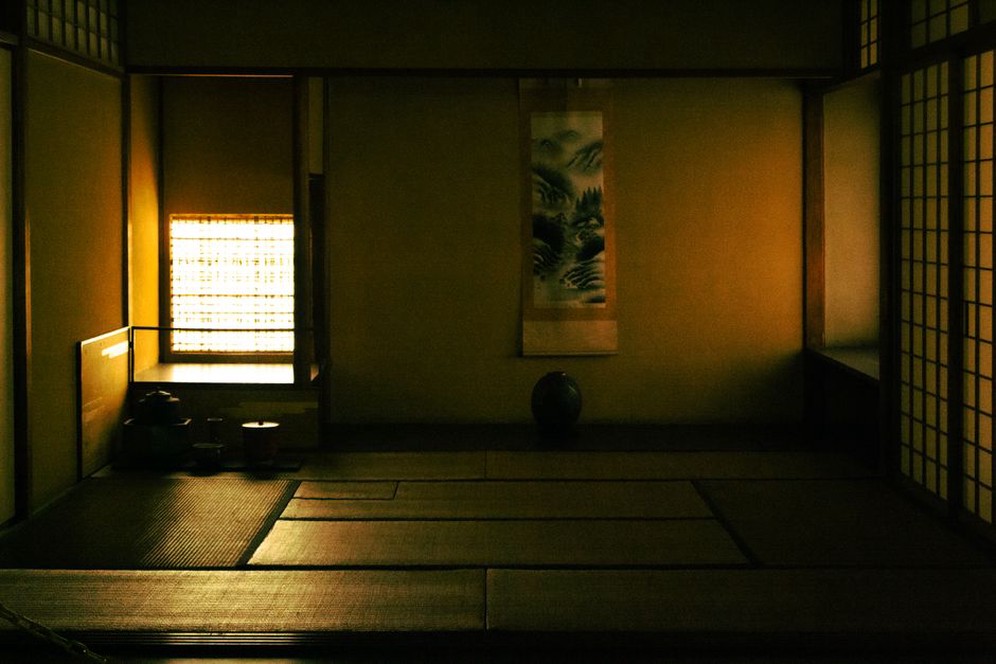
The Japanese term ma is often translated as “negative space,” though that phrasing can suggest blankness. In artistic use, ma is better understood as a meaningful interval: a temporal or spatial relation that gives surrounding events their force. In music, it may emerge between attacks, in a phrase’s delayed return, or in the distance between a sound and its reverberation.
Ambient composition can work with this principle without turning it into an exotic aesthetic. A sustained tone is not simply held; its overtones emerge as the listener’s attention shifts. A pause after a piano note allows the instrument, room, and recording medium to continue the phrase. An infrequent sound can establish scale because the ear measures the long interval around it.
What this means in arrangement
- Fewer layers can reveal more: removing a continuous pad may expose tape hiss, a room’s low resonance, or the uneven tail of a struck object.
- Events need not arrive on a grid: irregular entrances can make time feel observed rather than mechanically counted.
- Decay can be structural: reverb, feedback, and tape echo can determine when the next gesture belongs instead of functioning as decorative atmosphere.
- Silence needs a frame: a nearly empty passage gains meaning from what precedes and follows it, not from emptiness alone.
These methods appear in experimental music across many places. Their relevance to Japanese ambient practice lies less in national ownership than in the patient, detail-oriented forms of listening some artists and listeners have developed around them.
Attention to material and impermanence
Zen-influenced aesthetics are often discussed alongside wabi-sabi, another term routinely reduced to “beautiful imperfection.” They should not be treated as interchangeable. Wabi-sabi has a complex history involving tea culture, material age, modesty, incompletion, and changing conditions; it is not simply a preference for lo-fi sound. Still, it can help explain why weathered instruments, tape instability, and imperfect acoustics may be treated as expressive rather than corrected.
In ambient work, this may mean preserving small failures that define a recording’s character: a cassette’s wavering pitch, the noise of a piano mechanism, a cheap keyboard’s uneven sustain, or a microphone catching distant traffic. The point is not to fetishize damage. It is to recognize that sound has a physical history. A tone comes from an object, in a place, through a chain of machines, each with limits that change over time.
That sensibility can be heard in work by Hiroshi Yoshimura, whose compositions often balance unobtrusive function with closely shaped timbre and attention to environment. His music is regularly grouped under the modern label “kankyō ongaku,” or environmental music, a category covering varied composers and contexts rather than a unified style. It was connected to designed spaces, domestic listening, broadcast, commercial commissions, and technological optimism as much as to contemplative philosophy.
Ryuichi Sakamoto’s quieter work also shows why spiritual shorthand falls short. Across different periods, he worked with piano, electronics, field recordings, processing, collaboration, and themes of ecology and mortality. The sparse surface of some pieces comes from compositional decisions and recorded detail, not a generic image of Eastern calm.
Repetition as observation rather than hypnosis
Repetition is one of ambient music’s central devices, though its effect depends on scale. A loop can dull attention when it functions as wallpaper. It can also sharpen attention by making minute differences hard to ignore: a filter opens slightly, a tape loop drifts against itself, a delay loses high frequencies, or a performer’s timing shifts by a fraction.
Zen practice is sometimes invoked here because repeated bodily acts—breathing, walking, bowing, cleaning—can receive sustained attention. Used carefully, this is a useful parallel for musical process. A repeated figure need not symbolize meditation. It can create conditions in which listening notices variation that a busier arrangement would conceal.
| Technique | What changes over time | Listening effect |
|---|---|---|
| Tape loop | Pitch, texture, splice wear | The loop becomes a changing object rather than a fixed sample |
| Long feedback path | Harmonics, noise floor, balance | Small adjustments produce disproportionate shifts |
| Repeated acoustic gesture | Touch, resonance, breath, timing | Performance detail becomes audible |
| Slow digital processing | Spectrum, density, stereo position | Motion appears at the edge of perception |
For collectors and musicians, there is a simple test: hear a track once for recognizable events, then return to it for what refuses to remain identical. The second pass often reveals whether apparent stillness comes from compositional precision, passive looping, or a recording medium quietly asserting itself.
Environment is not automatically nature
Western marketing has often presented Japanese ambient music as an escape into gardens, water, and timeless calm. That picture misses much of the work. Japanese ambient and related experimental music have engaged with apartments, transit systems, consumer electronics, office architecture, broadcast technologies, and urban density. The environment may be a refrigerator motor, an air conditioner, a hallway, or the subdued electronic pulse of a public space.
Zen’s influence is more usefully understood here as a discipline of attention rather than a preference for “natural sounds.” Any sound can be heard as contingent and changing. A field recording does not become meaningful merely because it includes wind or birds; its framing, editing, context, and relation to other sounds determine what it asks the listener to notice.
This also places ambient music close to noise and electroacoustic work. Quietness and harshness are not opposites when both expose texture, duration, and the instability of listening. A low drone may be physically demanding, while a noisy recording may produce intense focus. The broader relationship is explored in the blog’s examination of the philosophy of noise in Japanese music, where noise is treated as more than excess or aggression.
The danger of “Zen ambient” as a shortcut
Calling Japanese ambient music “Zen ambient” can erase individual methods and historical conditions. It can imply that Japanese artists naturally make contemplative music, while similar work elsewhere is classified through technology, minimalism, new age, sound art, or experimental composition. Culture becomes atmosphere rather than context.
A more precise description names what is actually heard and how it was made. Is the piece built from untreated field recordings? Does it use restrained harmonic movement, slowly evolving synthesis, tape collage, prepared piano, or near-silent dynamics? Was it intended for a gallery, public installation, home speaker, cassette edition, or live performance? Such details say far more than a generalized spiritual tag.
A listening vocabulary that avoids the shortcut
- Describe the sound source before assigning an emotion: bell-like oscillator, room resonance, filtered radio, bowed metal, or untreated piano.
- Identify the time scale: seconds between gestures, a loop’s duration, or the rate at which a texture changes.
- Notice the recording’s material evidence: edits, microphone distance, saturation, compression, and background noise.
- Separate personal response from cultural claim: “this feels contemplative” is more accurate than “this is inherently Zen.”
- Check context where available, especially commission notes, performance settings, collaborators, and stated artistic methods.
For musicians working with these ideas, start with one sound and a fixed duration: perhaps ten minutes of lightly processed piano resonance or a cassette loop without added percussion. Record the full pass, then remove a single element on the next take. Compare the tails, gaps, and unintended noises before deciding if another layer is needed.