
A noise performance can grow so dense that another layer of distortion seems impossible to pick out. Then it cuts to near-silence, and the room becomes audible. The limit was never just loudness. It was how much the listener could separate within the sound—and how precisely the performer could change that.
Japanese noise music is often described in terms of volume, distortion, duration and confrontation. Those qualities matter, but “as loud as possible” tells us little about what a piece is doing. A dense signal can conceal tiny rhythmic shifts; a quiet electrical buzz can make audibility itself feel uncertain. The better question is which boundary a work tests—equipment, perception, performance or musical form—and what happens when it reaches that boundary.
What counts as a sonic limit?
“Noise” means different things in different settings. In acoustics, it can be an unwanted signal. In music, it may mean sound without stable pitch, sound treated as interference, or material ordinarily left out of composition. Japanese noise has no single sound or technical method. The label includes feedback-heavy performances, but it also borders quieter practices concerned with sparse sound, room tone and listening itself.
Nor is a limit always a maximum. Turn a mixer down until its electrical residue becomes the main event, and you are testing a minimum. Let a sound continue until its changes become hard to track, and duration becomes the pressure point. Follow an intricate passage with a hard stop, and perception has to catch up. None of this requires admiring severity for its own sake.
Merzbow—Masami Akita’s project and one of the most visible names associated with Japanese noise—offers one example. Its extensive recordings often contain dense, shifting layers that resist familiar instrumental roles. But Merzbow is not a template for everyone working under the noise label. Make that approach the definition, and the quieter, more structurally varied edges become harder to hear.
From unruly sound to an organized practice
Japanese noise has no single founding moment. It grew amid overlapping interests in free improvisation, experimental electronics, performance art and underground distribution. Its unstable materials do not rule out deliberate decisions. Feedback changes with placement, gain and room acoustics. Distortion alters whatever enters it, sometimes unpredictably. Even a seemingly continuous mass has entrances, interruptions and shifts in proportion.
Japanoise became a convenient international label, especially for Japanese artists associated with forceful electronics. It helps locate a history of recordings and performances, but can flatten differences into a supposed national style. No inherent Japanese preference for loudness or extremity explains this music. Artists made choices within particular scenes, using the devices, collaborators, venues and distribution channels available to them.
Consider Hijokaidan, long associated with sustained, high-energy group noise, and Incapacitants, whose electronics follow their own volatile forms of intensity. Neither is interchangeable with Merzbow. The useful comparison is how each act handles density and movement, and how each negotiates deliberate action against unruly response.
Four boundaries a noise work can test
1. The signal chain
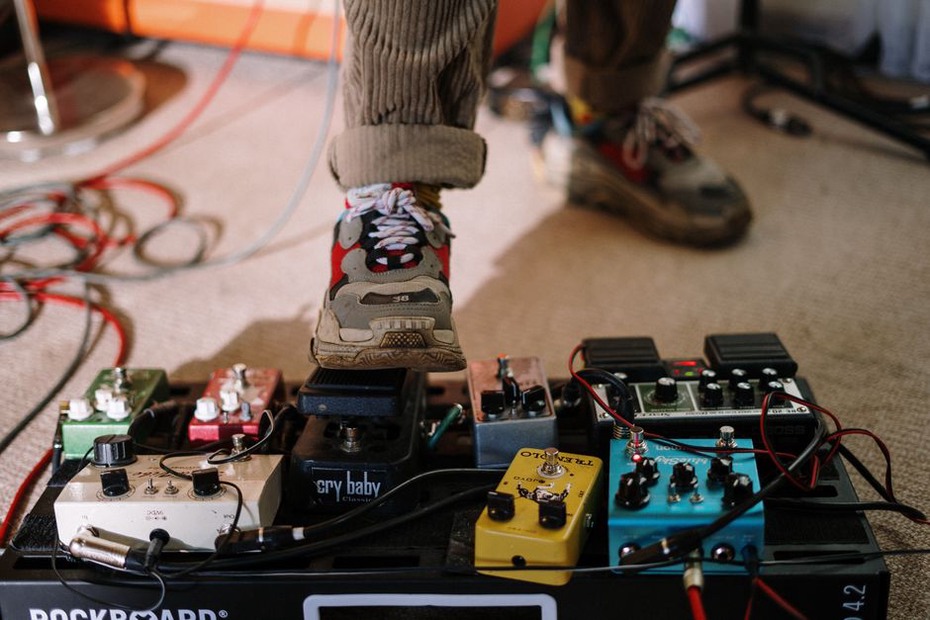
Feedback, clipping and overloaded effects need not be flaws left uncorrected. They can supply the piece’s material. Put a microphone near a speaker and sound returning through the room re-enters the system. A slight movement or gain adjustment can change its pitch and intensity. Across several devices, one control may alter several sounds at once.
The signal chain becomes a responsive instrument rather than a neutral means of amplification. A performer can set conditions and learn its tendencies without controlling every outcome. “Uncontrolled” does not mean “uncomposed”: form may depend on how long an unstable sound is allowed to develop, or exactly when it is cut off.
2. Hearing within density
Sounds in similar frequency ranges can mask one another. A detail may be present in a recording yet hard to hear beneath a louder layer. Dense noise puts that feature of hearing to work. Turning the level up will not necessarily disclose more; a drop in volume or a shift in frequency balance may expose movement that seemed absent.
Compression can alter the sense of motion too. Narrow the contrast between soft and loud moments, and the sound may seem constantly close even as details move within it. Relentlessness can contain considerable variation. The same recording might also sound enormous on one playback system and flat on another. Its apparent limit belongs partly to the listening setup, not just the file or record.
3. The performing body
A live set has physical limits that a recording cannot fully convey. Hands can operate only so many controls. Equipment may respond differently as it warms, and the performer must decide when to change course. Listeners can move away from a speaker or leave the room; their positions change both sound pressure and the balance of direct sound and reflections.
Some Japanese noise performances have used endurance, abrupt gestures and theatrical disruption. These are possibilities, not requirements. Physical intensity can make a work’s conditions visible, but so can a restrained movement that produces a disproportionate change in sound.
4. Time and form
Noise can withhold the cues that usually tell us where a piece is headed. Without a steady beat or recurring melody, a minute may feel unusually long. A sudden stop can carry more weight than a conventional climax. The structural question becomes: how long can a texture remain recognizable before its small changes take over our attention?
An extended passage does not always demand constant close listening. Some works move between absorption and interruption. Missing a subtle event is not necessarily a failure: a later cut, return or contrast may be what makes the earlier change legible.
Maximum volume is not a listening requirement
Loud playback can make low frequencies and physical pressure more apparent, but it is no guarantee of a clearer account of the music. At excessive levels, masking can increase and fine distinctions disappear. Sustained loud sound poses a real hearing risk, particularly at shows where levels and speaker positions vary. Earplugs designed for music can reduce exposure. Moving farther from the speakers changes what you hear without forfeiting the performance.
On headphones, start at a moderate level rather than matching the setting you used for a quieter track. A recording may begin softly and rise without warning. If you feel pain or pressure, or hear ringing, turn it down or stop. No musical insight depends on pushing through those signs.
To compare sections, keep the volume fixed for a while. Does the passage grow more crowded? Does its apparent pitch center move? What background sound emerges after a cut? Repeatedly turning up the level in search of detail changes the comparison—and can turn a question about structure into one about tolerance.
When restraint tests the boundary
Sonic limits can be tested quietly. Sachiko M’s use of sine waves poses a markedly different challenge from a wall of distortion. A sparse, stable tone exposes small changes in pitch or level, along with noise around it. Ventilation, electrical hum or uneven hearing across frequencies may become noticeable. The composition and the room are difficult to separate.
Onkyō, a term associated with an approach to improvised music in Japan around the turn of the millennium, also directs attention to reduced gestures and the conditions in which sound is heard. It should neither be folded into noise nor cast as its simple opposite. Both can disturb assumptions about what deserves attention. Dense sound makes events difficult to isolate; sparse sound can give a faint event nowhere to hide.
Silence, then, is more than relief after loudness. At a performance, a pause can expose room noise or a listener’s movement. On a recording, it might reveal hiss or the surface sound of the format. Quiet has audible conditions of its own.
Why the recorded version has different limits
At a show, speakers, room acoustics and your position all shape the sound. A recording fixes one balance and sends it through another chain of devices. Microphones and recorders can saturate; mastering can alter dynamic range; cassette and vinyl can add audible artifacts. That does not automatically make a release less authentic. It documents an event while changing it, rather than carrying the room intact to another place.
Format matters especially when the music works at extremes. Hiss changes the feel of a quiet passage compared with the same passage in a low-noise digital file. Bass felt bodily at a show may barely register on laptop speakers. There is no need to declare one medium definitively correct. Describe what you heard, and on what playback system, before making claims about an artist’s intentions.
Release credits may tell you more than the broad label “noise.” Personnel, recording location, live or studio designation, and listed equipment—when a release supplies them—can help distinguish a group performance from a layered construction. If that information is absent, do not fill the gap with a plausible story. Collectors handling ambiguous tapes face this problem acutely; Cataloging Japan’s Experimental Music Tapes Without Guesswork looks at how to describe such objects without inventing provenance.
A closer way to compare extremes
Peak intensity alone says little about how two noise pieces organize attention. A few observations offer a better basis for comparison:
- Density: Can you distinguish the layers, or do they merge into one mass?
- Change: Do shifts arrive gradually or abruptly? Can you locate them at all?
- Frequency: Does the emphasis move among low pressure, midrange abrasion and high tones?
- Space: Can you hear distance or room reflections, or does the sound seem close and flattened?
- Cutoffs: What becomes audible immediately after a pause or ending?
You need not identify every device. A buzz could come from feedback, a processed instrument or a recording artifact. Describing what it does is often more accurate than assigning a source by ear. For practical ways into a first encounter, How to Listen to Japanese Noise Music is a listening-focused companion to these structural distinctions.
Try replaying one transition at the same moderate volume: ten seconds before a sudden cut and ten seconds after. First hear the obvious change. Then listen for what had been masked—a pulse inside the dense passage, perhaps, or room noise exposed by the stop. In that moment, the boundary is not a number on the volume control. It is where one sound lets you hear another.