
Hold a note long enough and it stops behaving like a point on a scale. Its overtones come forward; a slight change in pressure starts to matter; another pitch may seem to appear without anyone playing it. Japanese drone music often works at this level of attention. The material is not just a long sound, but the changing relationship between a sustained tone, its source, and the space where it is heard.
“Drone” names a method, not a single Japanese scene. Bowed strings, held organ notes, guitar feedback, oscillators, amplified objects, and processed layers can all produce it. Some works are quiet enough to expose a room’s background noise; others have the force of noise music. The question is less whether a piece stays on one note than what happens while it seems to stay put.
Duration is a compositional material
A sustained tone is never perfectly static outside an abstract diagram. A bow changes speed and pressure. An amplifier distorts more as its input rises. Two oscillators drift slightly apart. Even a recording of an apparently fixed electronic signal may reveal slow shifts in level, timbre, or interference. By leaving out faster events that might compete for attention, drone composition brings these movements forward.
La Monte Young and other international minimalists offer one historical route into sustained sound, but Japanese drone is not an offshoot of any single lineage. Postwar experimental composition, improvisation, psychedelic rock, noise, and independently produced recordings have brought different tools and priorities to it. A patient acoustic resonance and a wall of saturated guitar may both sustain, yet they ask for very different kinds of listening.
Three ways a drone changes without changing note
- Beating: Two close frequencies alternately reinforce and cancel each other, creating audible pulses. As the pitches move closer or farther apart, the pulse rate changes.
- Spectral change: The perceived fundamental pitch holds while upper partials grow, fade, or distort. A note can turn abrasive without a new melody.
- Spatial change: Reflections, speaker placement, and the listener’s position affect which frequencies dominate. Walk across a room and a stable tone may seem to rearrange itself.
These processes can sound like effects added afterward. In many performances, they are the main events. A slow increase in roughness can carry as much weight as a chord change elsewhere.
Distinct approaches, not one national sound
Keiji Haino’s work shows how unsettled a sustained sound can remain. Across his extensive solo and collaborative practice, voice, guitar, and electronics often move between held tones and violent interruptions. Continuity is strained rather than offered as a calm surface. A vocal tone roughens, a guitar signal blooms into feedback, or an apparent plateau breaks apart: the duration gives the performer something to push against.
Sachiko M takes a markedly different approach. In improvised performance, her use of the sampler’s test tones strips away much of the gesture associated with conventional instruments. A high, steady sine tone makes tiny changes, interruptions, and the surrounding acoustics unusually conspicuous. Drone need not be warm, enveloping, or rich in harmonics. A nearly bare signal can be exacting.
Ryoji Ikeda’s electronic work offers another comparison, though it should not all be filed under drone. Sustained high frequencies and low-frequency energy can operate alongside sharply organized digital patterns. An extended tone may be central to a passage without making the whole piece a continuous drone. What happens in the work tells us more than one label attached to an artist’s catalogue.
On the heavier side, Boris have repeatedly used prolonged electric-guitar sound and amplification alongside rock, metal, and other approaches. Here, sustain is bound up with volume, distortion, and the time a vibrating string or amplifier takes to decay. A low chord may register less as a stable pitch than as a mass of interlocking frequencies. Taken together, these artists do not define “the” Japanese drone sound; they show how far the simple act of prolonging sound can be taken in different directions.
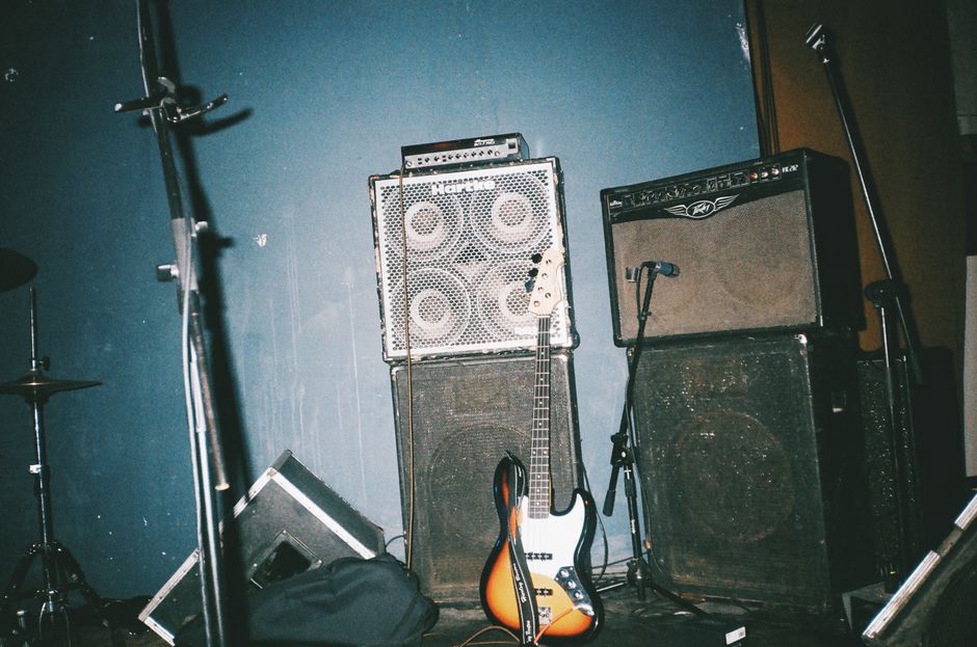
Where the sustained sound comes from
Feedback is a loop, not just an effect setting. Sound leaves a speaker, returns to a microphone or guitar pickup, is amplified, and circulates again. Distance, angle, room acoustics, and gain affect which frequencies take hold. Feedback responds to a performer’s movement but is difficult to reproduce exactly: moving a guitar a few centimeters can reshape a prolonged tone more dramatically than changing a written note.
Oscillators and test tones offer a different kind of control. Because a sine wave has a relatively simple spectrum, its interaction with another tone is easy to hear. An oscillator can hold a frequency steadily or move through narrow intervals where beating becomes pronounced. That apparent simplicity is unforgiving. A small level change can alter the balance of an entire piece, and harsh upper frequencies can quickly become tiring.
Acoustic instruments have their own instabilities. A bow can sustain a string, but its contact changes from moment to moment. Breath instruments tie continuity to the player’s body. Bells and resonant objects cannot ordinarily sustain indefinitely, so performers may repeat, overlap, or amplify their decays. Calling all these results “a drone” should not erase the different labor and limits of each source.
Recording technology can extend these sounds without making their sources interchangeable. Looping repeats a segment; overdubbing stacks separate performances; reverb prolongs and disperses a decay. Each changes what a listener can infer about cause and time. A loop may return the same irregularity on every cycle, while small deviations accumulate in an unlooped performance.
What the room and recording add
Because of room modes, low frequencies may gather near a wall or disappear at a particular listening position. High tones can feel sharply localized through one set of speakers and less so through another. At substantial volume, the playback environment becomes part of what is heard. A concert, headphones, and small desktop speakers can therefore give quite different impressions of the same passage.
Microphone placement makes a difference too. A close microphone can emphasize a speaker cone’s direct output; one placed farther away captures more of the room. Stereo may retain some sense of moving sound or interacting reflections, but it cannot guarantee the physical experience of a live performance. Nor is a rough recording necessarily a failed one. Hiss, distortion, and limited frequency range may reflect the equipment and the route by which a piece reached listeners.
With small-edition or informally traded recordings, it helps to separate what you can hear from what the credits can establish. Sleeves, reissues, and digital files may disagree about a performance’s date, personnel, or source instrument. The wider context of [cassette labels in Japan’s experimental underground] helps explain why a physical release and its documentation matter alongside the sound. If neither the recording nor its credits establishes the instrument behind a tone, any identification should remain provisional.
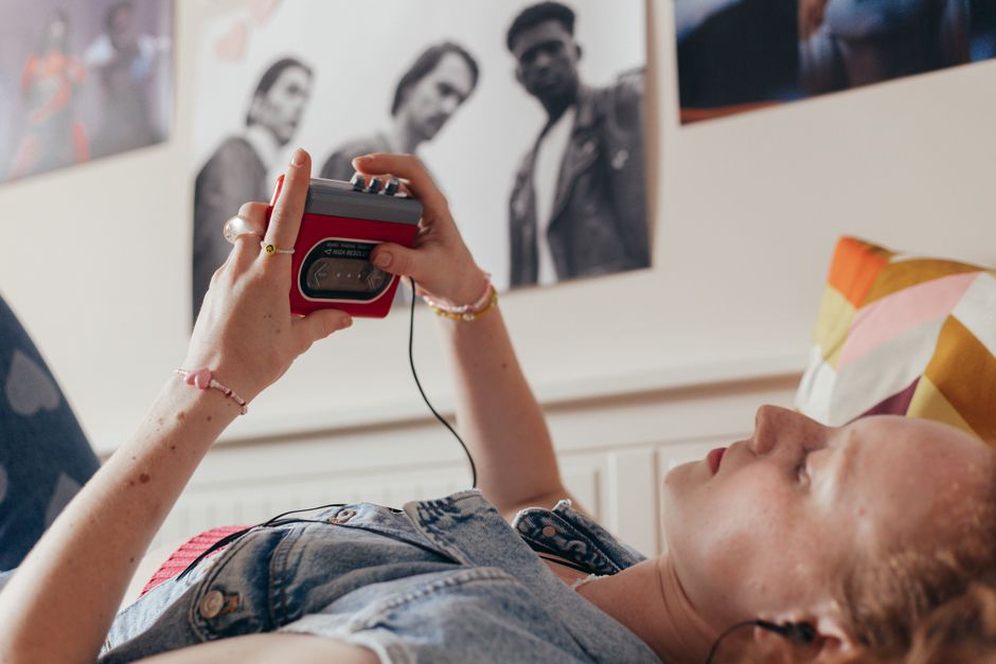
Listening for structure rather than waiting for a melody
Drone rewards attention at different scales. A piece might trace a clear arc—a slow rise, a sudden cut, a long decay—while its moment-to-moment activity lies in beating and shifting harmonics. Hear the large shape first, then return to a short interval. If a tone seems to swell, is the whole sound getting louder, or is one frequency becoming more prominent? The distinction may point to different techniques.
- Identify the stable element. Is it a pitch, a band of noise, a repeated loop, or simply an unbroken level of energy?
- Track one moving element. Follow the pulse between close tones, the edge of a distortion layer, or an overtone as it emerges and recedes.
- Notice the boundary. An entrance, interruption, or cut reveals how the work treats continuity. Silence may be a structural decision rather than a pause for relief.
- Compare playback conditions carefully. Try another listening position or a moderate volume before deciding a low tone is absent from the recording.
Moderate volume is a sensible starting point, especially with sustained high frequencies or bass-heavy passages. Extended exposure can be uncomfortable even when a recording does not initially seem loud. Turning it down does not rule out close listening; it may make movement within a dense sound easier to follow.
The limits of the label
“Japanese drone” can help listeners find connections, but it can also flatten differences in origin and intention. A performer may come to sustained sound through free improvisation, studio electronics, amplified rock, or acoustic resonance. The label alone says little about whether a performance is planned, whether its source is audible, or whether it calls for quiet concentration or a high-volume physical encounter. It works best as a description of how sound behaves in a particular work, not a complete identity for its maker.
Try playing two sustained passages at a comfortable level and marking the first audible change in each. A new pitch may enter one; in the other, the pitch may hold while a rough upper band gradually appears. Calling both “unchanging” would miss the event each is built around.