
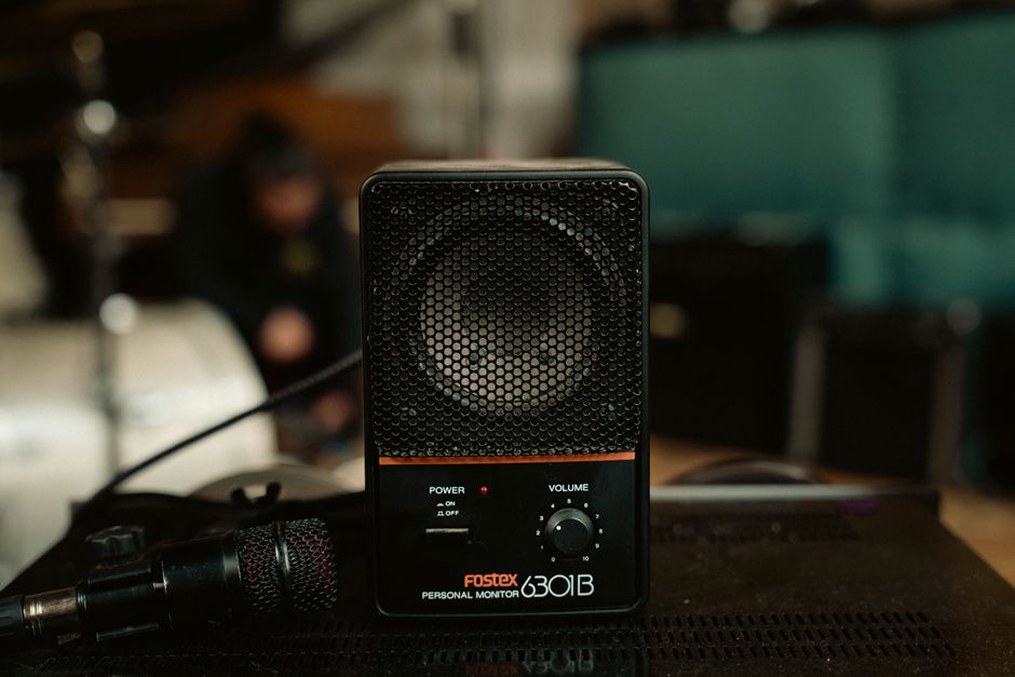
Move a microphone closer to a speaker and the feedback tone changes. The gesture may be deliberate, but the precise result depends on distance, room acoustics, gain and the frequencies already sounding. In Japanese noise performance, improvisation often happens in that gap: the performer makes a choice, hears the system answer, then decides whether to follow it, cut it short or try something else.
This is more specific than calling a set a stream of spontaneous ideas. The equipment may be prepared, the gestures familiar, even the duration planned. The route between those points remains open. Rather than asking only whether a sound was improvised, ask which decisions could still change once the performance began.
Where the uncertainty enters
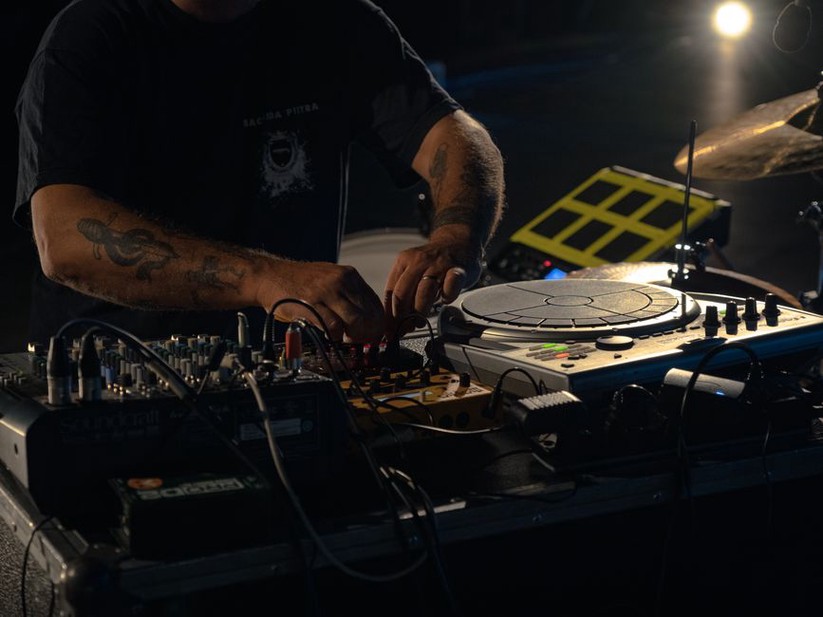
Noise musicians improvise with more than notes. Distortion can hide a small input change until it suddenly becomes dramatic. A cable connection may crackle intermittently; two loud sounds can mask each other, forcing a performer to adjust levels by ear. Skill lies partly in timing, restraint and recovery when the equipment behaves this way.
Different setups leave different things undecided:
- Feedback systems allow a performer to steer pitch and intensity through placement, gain or equalization, though the fine details remain hard to predict.
- Effects chains turn a small source—voice, instrument or contact microphone—into material that can be cut, accumulated or radically altered in real time.
- Tapes and prepared recordings supply fixed sounds, while leaving their entry points, layering and treatment open during a set.
- Acoustic objects make pressure, friction and the material’s physical condition consequential. The same gesture need not produce the same sound twice.
None of these tools guarantees improvisation. A densely wired table may deliver a rehearsed sequence, while a musician with one instrument makes consequential choices moment by moment. What matters is how the performer responds to what happens, not how chaotic the setup looks.
Structures that survive without a score
An improvised noise set need not be a steady climb in volume or density. A performer might return to a small group of sounds—short bursts, a sustained low tone, abrupt dropouts—while changing the space between them. Recurrence gives the listener something to compare. The second burst may arrive sooner, last longer or cut across a sound that was absent the first time.
Density can shape a set just as strongly. Adding layers increases pressure; removing one may expose a faint pulse or room reflection that was there all along. A sudden stop changes what performers can hear from one another, and may leave an amplifier hum or an effect tail exposed. A stop is not automatically expressive. Its force depends on where it falls and what happens next.
Merzbow’s recordings offer a caution against reading too much process into momentum. Masami Akita’s large catalogue draws on varied sources and production methods, so a recording that sounds as if it is gathering speed does not prove every change happened live, without preparation. Nor does prepared material make the decisions taken during a performance inconsequential. Arrangement and improvisation can coexist.
Improvising with other people
In an ensemble, volume is only one way to claim space. A performer might answer a harsh sustained band with something quieter in another register, or wait for it to end. Some groups trade sounds rapidly; others hold a texture long enough for small shifts to register. Equal contributions at every moment are not a requirement.
Hijokaidan, associated with extended, volatile performances, show how ensemble noise can consist of overlapping individual actions rather than one synchronized build. They are not a template for all Japanese noise. Toshimaru Nakamura’s no-input mixing board practice offers a different kind of live negotiation: routing a mixer’s outputs back into its inputs creates a feedback instrument that can be shaped but cannot be controlled like a conventional keyboard. In collaboration, its behavior must also be adjusted against what others are doing.
It is safer to listen for interaction than to guess at intentions. If one player stops just after another introduces a new texture, the stop might be a response—or it might have been planned. A pattern of yielding, interruption and return makes a stronger case than a single coincidence. On a recording, even that can be difficult to judge when the mix obscures who made which sound.
What a recording leaves out
A live noise recording captures audible decisions, not the whole situation in which they were made. It may leave out a performer’s movement, the distance between sound sources, or the difference between what was heard onstage and at the recorder. Compression and playback level can make a quiet intervention sound like a sharp contrast—or bury it under a louder layer.
Collectors have good reason to read release information carefully, but it is not a complete account. A live designation identifies a performance context, not necessarily an unedited document; a studio credit does not rule out improvisation. Multiple takes, overdubs and edits all affect what kind of interaction can be inferred. When those details are unavailable, it is more accurate to say that a recording sounds responsive than to claim its process is known.
Listening for decisions, not just intensity
High volume can make a set feel immediate, but it says little on its own about how decisions were made. For close listening, follow one feature through a short passage, then replay it with your attention on another:
- Mark each clear entrance or exit of a sound source. Do not assign it to a performer unless you can identify the source.
- Notice whether changes in level coincide with changes in pitch, texture or rhythmic activity.
- Listen for a sound that persists after the dominant layer stops. Was it there earlier, unnoticed?
- Compare repeated events. Do their differences develop gradually, or does one seem to prompt a change elsewhere?
This way of listening is more useful than treating “Japanoise” as a single method. The label can help locate recordings, but it covers different relationships to free improvisation, electronics, rock performance and composition. Musicians work across those categories; a release may do so too. Listen to the interaction in a particular passage before drawing conclusions from a genre label.
Try it with thirty seconds of a live recording. Note when the loudest layer drops out, then replay the preceding ten seconds at a comfortable level. You may hear a quieter sound entering before the dropout: what seemed like an abrupt ending might have been a handoff.