
A contact microphone on a sheet of metal does more than make the metal louder. It catches vibrations an airborne microphone might barely register: a fingertip dragging across the surface, the sheet flexing, a small impact travelling toward the pickup. Run that signal through distortion and amplification, and a scrape can become a dense, sustained sound. The question then is which traces of the original gesture remain audible.
Japanese noise artists have taken strikingly different approaches to that question. Pedals, homemade circuits, recorded material and amplified objects offer possibilities, but no tool guarantees a particular sound. The choices lie in the input, the limits of the setup and what happens at the point where a signal changes character.
Distortion is a decision, not a genre
Merzbow, Masami Akita’s long-running project, makes a useful starting point precisely because its catalog resists a single recipe. Tape-era work and later digital or electronic recordings do not share one fixed setup. Across that range, saturation, layered signals and sudden shifts in density can make a recognizable source hard to pick out. Distortion adds harmonic content and narrows the gap between quiet and loud details. When several distorted layers compete, a small change in one can unsettle the whole balance.
Listen to the transitions rather than hearing a loud passage as one solid block. Does a high band rise above a low rumble? Can you still hear a repeated pulse after another layer enters? Those questions place the manipulation in time. They also challenge the idea that noise is simply a matter of volume: a recording can sound aggressive even at a low playback level if its frequency balance, transients and compression have been shaped that way.
Feedback makes the system audible
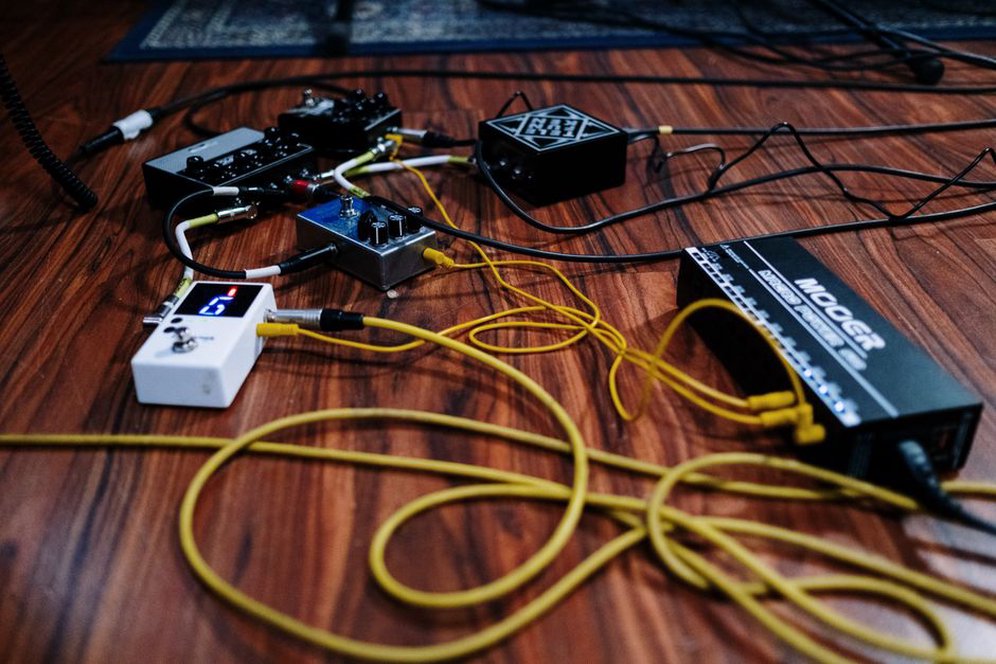
Feedback begins when output returns to an input and is amplified again. With a microphone and speaker, moving either one changes the loop. Routing and gain can produce feedback inside an electronic chain without an open microphone. Equipment matters, but so does how close the performer takes the loop to instability.
Toshimaru Nakamura’s no-input mixing board makes this especially clear. He connects a mixer’s outputs back into its inputs and plays the resulting circuitry rather than mixing external instruments. Faders and equalization shape a self-generating signal. The sound can be sparse, brittle or abruptly loud. “No-input” means there is no conventional source feeding the channels, not that sound appears without a physical system.
A performer can steer a feedback loop toward a frequency without predicting every event it will produce. A control may cross a narrow threshold; the performer then responds to the change. That exchange between setup and response is more revealing than calling the machine either fully controlled or fully autonomous. For a closer account of circuits as instruments, DIY electronics in Japanese experimental music examines signal paths, failure and documentation.
Three ways a source can change
- Amplification brings a faint physical event forward. Contact microphones and pickups can reveal vibration within an object while leaving out much of the surrounding air.
- Processing alters a captured signal. Filtering removes or emphasizes frequency ranges; delay repeats events; clipping changes their shape and adds overtones.
- Recirculation sends sound back through the system. Feedback can stretch a short impulse into a continuing tone or make a tiny adjustment produce a large change.
These methods overlap, but the distinction helps when listening. A metallic shriek might come from a struck object, an electronic oscillator or feedback. Resemblance to metal proves little. Its attack, repetition, pitch stability and response to other sounds offer better clues.
Objects, gestures and the edge of audibility
Otomo Yoshihide has used turntables for more than straightforward record playback. The stylus, the handling of a record, the motor and the amplification chain can all contribute sound. A scratch or interruption need not be a blemish on a track underneath; it may be the event around which a performance turns. Otomo’s work extends far beyond turntable noise, so the device is one part of a changing practice, not his defining method.
At another scale, Sachiko M is known for using a sampler with no sounds loaded, drawing on its test tones instead. A steady sine tone leaves little to hide behind. Changes in pitch or duration, and the silences between tones, become conspicuous. Here, precision puts pressure on listening where a thick surface might otherwise do the work.
Both performers foreground an electronic device, but they ask different things of it. One brings friction and interruption into focus; the other restricts the signal until small adjustments carry the form. There is no need to assign either approach an imagined “Japanese” sonic signature. The operations are audible enough.

What a recording does not tell you
A finished track rarely maps its own production. Different signal chains can yield similar sounds, while mastering changes perceived loudness, width and detail. A live recording complicates matters further: the room, speaker placement and recording microphone all affect what reaches you. A harsh tone in a video may have sounded quite different to someone standing beside the performers.
Release notes, equipment photographs and interviews can clarify a method when they are available. They cannot necessarily account for every audible event. It helps to separate observation—“the pitch rises while the texture thins”—from a possible explanation, such as a filter sweep. In improvised work, the signal path itself may change during the performance.
A closer way to hear the manipulation
- Choose a short passage and mark the first sound whose source seems uncertain.
- Replay it at a moderate level, listening separately to its attack, sustained portion and ending.
- When a second sound enters, note what changes: pitch, density, rhythm or apparent distance.
- Only then try a production hypothesis. Keep it provisional unless the artist has documented the setup.
Moderate playback helps with more than comfort. At excessive levels, dense material can mask the quiet clicks or narrow tones that show how a passage develops. If a burst seems to come from nowhere, go back one second: a faint repeated tick or rising whine may already be setting it in motion.